Source A is a 1948 photograph showing a gravel road, two shops and no marked pedestrian crossing. Source B is a recent council map showing a sealed road, a crossing and a larger commercial area. Both sources show the same intersection from different time periods.
Fluency check: read the source aloud once at a natural pace, pausing where the punctuation tells you to.TERM 1 · WEEK 6
Local History Trail
History
0 / 7 missions complete
ENGLISH
Punctuation & Apostrophes
01 · WorkshopPunctuation helps readers understand writing. An apostrophe can show who owns something. Let’s try it with one owner at a time.
WHAT AM I LEARNING?
I can use punctuation to make meaning and quotations clear.
YOUR MISSION
Which sentence correctly quotes a source?
TEACH · APOSTROPHES SHOW OWNERSHIP
Hana owns the notebook.
Hana’s notebook.
Hana is one owner. Add an apostrophe and s to the owner’s name: Hana + ’s. This tells us the notebook belongs to Hana.
Tap a punctuation mark to learn what it does.
PRACTISE · Who does it belong to?
Tap words to collect and compare them.
YEAR 5 DEEP DIVE · REQUIRED Complete this deeper Year 5 mahi as part of the mission — not as an optional extra.
Do the main mission first, then complete this section. It is deliberately more independent than Year 4 and is part of your weekly homework workload.
CHECK THE CORE IDEA
Which sentence correctly quotes a source?
ENGLISH
Sequencing Events & Finding Evidence
02 · LibraryRead the Local History Trail information first. Talk the idea through, then answer one small question at a time.
WHAT AM I LEARNING?
I can compare information across two parts or sources and explain similarities and differences.
YOUR MISSION
What can be concluded safely?
TEACH · LEARN THE IDEA
Comparing means checking what is the same, what differs and whether the sources answer the same question. Use evidence from both.
- STEP 1Read once to understand what it is mostly about.
- STEP 2Read the question again and find the part that helps.
- STEP 3Say your answer aloud using because, then check it against the text.
- STEP 4Record a useful clue from the source.
- STEP 5Explain what that clue tells you.
TEACH · Read this first
Source A is a 1948 photograph showing a gravel road, two shops and no marked pedestrian crossing. Source B is a recent council map showing a sealed road, a crossing and a larger commercial area. Both sources show the same intersection from different time periods.
CHECK THE TEXT · Find a clue
A clue from the text is called evidence.
YEAR 5 DEEP DIVE · REQUIRED Complete this deeper Year 5 mahi as part of the mission — not as an optional extra.
Do the main mission first, then complete this section. It is deliberately more independent than Year 4 and is part of your weekly homework workload.
CHECK THE CORE IDEA
What can be concluded safely?
ENGLISH
Writing a Chronological Paragraph
03 · Creative StudioYOUR WRITING JOB: Write a short chronological account comparing the place in the older source with the place today. Use dates or time markers and evidence.
WHAT AM I LEARNING?
I can write an informative report that groups related ideas and uses evidence.
YOUR MISSION
Write a short chronological account comparing the place in the older source with the place today. Use dates or time markers and evidence.
TEACH · LEARN THE IDEA
Reports use a clear focus, grouped information and accurate vocabulary. Select evidence that supports the purpose and avoid irrelevant detail.
- STEP 1Introduce what you are writing about.
- STEP 2Give your first important idea.
- STEP 3Add another useful detail, reason or example.
- STEP 4Finish so the reader understands your message.
NEED TO GET YOUR IDEAS READY?
Choose any way that helps. These are optional — you can always do the whole mission on screen.
ON SCREEN — use the planning boxes below.PEN & PAPER — if you want to, draw or jot your ideas first.SAY IT OUT LOUD — explain your idea to yourself before writing.TALK IT THROUGH — if someone is available, you can talk with a friend, sibling, whānau member or adult.
PRACTISE · Plan it one step at a time
SELF-CHECK · Check your work
This checklist helps you check your work. You do not have to tick every box to submit — the mission check looks at the work you created.
YEAR 5 DEEP DIVE · REQUIRED Complete this deeper Year 5 mahi as part of the mission — not as an optional extra.
Do the main mission first, then complete this section. It is deliberately more independent than Year 4 and is part of your weekly homework workload.
YOU TRY
Write a short chronological account comparing the place in the older source with the place today. Use dates or time markers and evidence.
Minimum guide: 90 words. Quality matters: make the reasoning, evidence or design decision clear. □ answers the exact task□ uses specific detail□ ideas are connected□ reread and improved
MATHS
Reading Grid References & Pathways
04 · Maths LabWork through one maths question at a time. Your answers will be checked before the next mission unlocks.
WHAT AM I LEARNING?
I can reason with angles, coordinates, symmetry and transformations.
YOUR MISSION
1) A map scale is 1 cm : 250 m. 6 cm represents how many metres? 2) Quarter-turn clockwise from north points…
TEACH · LEARN THE IDEA
Geometry uses precise language. Describe location with coordinates, turns with angle measures and transformations by what changes or stays the same.
- STEP 1Read the question and decide what you need to find.
- STEP 2Notice the important numbers and units.
- STEP 3Choose a strategy and work it out.
- STEP 4Type the answer, then check that it makes sense.
PRACTISE & SOLVE · One question at a time
Read → choose a strategy → work it out → check your answer. Correct answers stay correct if another question needs another go.
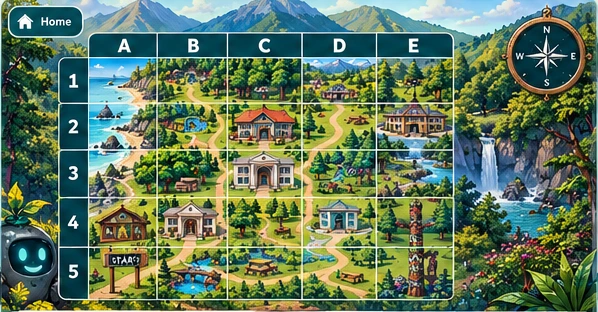
North ↑ · Columns run A–E from left to right. Rows run 1–5 from top to bottom. C2 is north of C3.
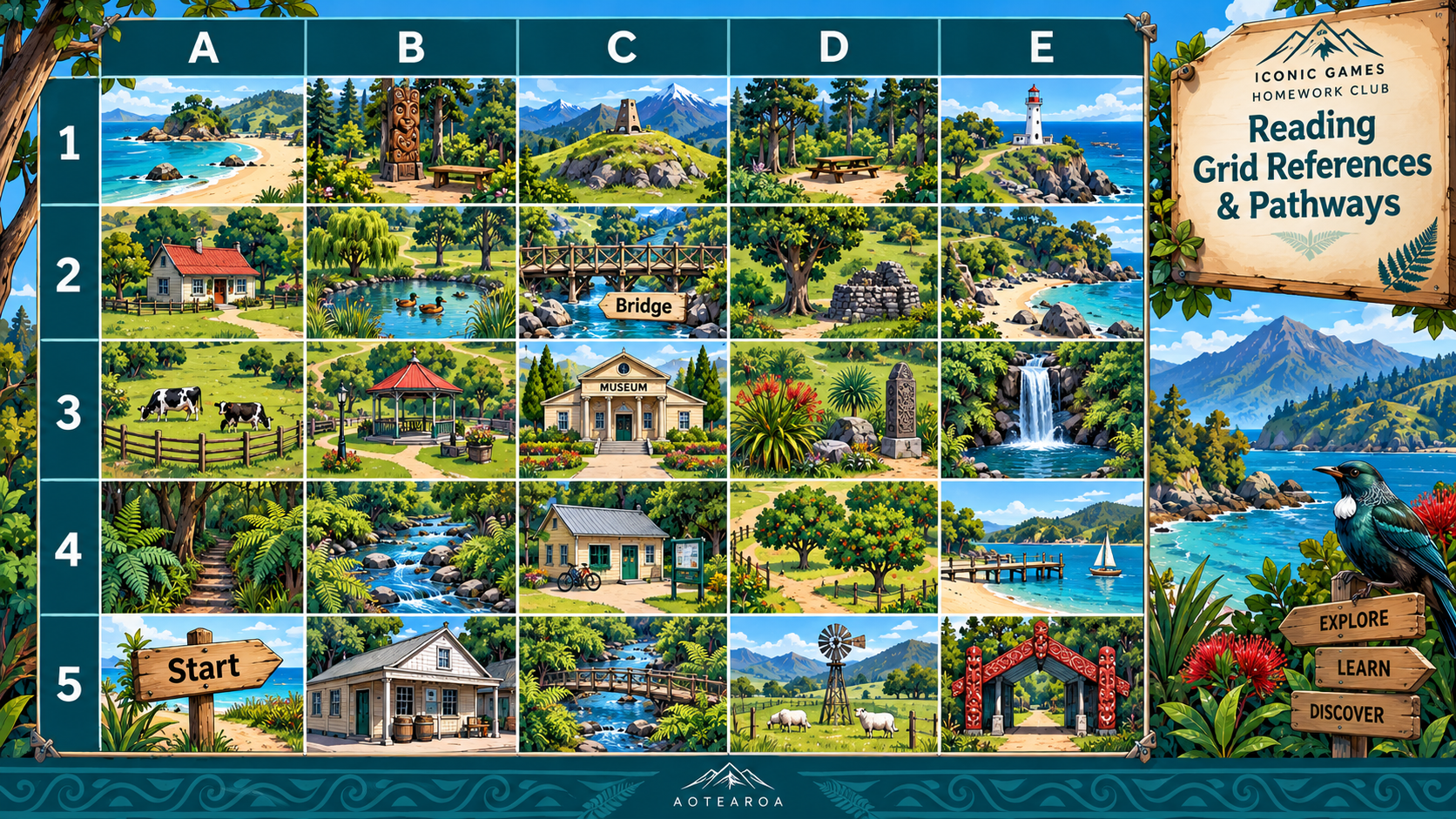
Tap a place on the illustrated map to explore its grid reference.
YEAR 5 DEEP DIVE · REQUIRED Complete this deeper Year 5 mahi as part of the mission — not as an optional extra.
Do the main mission first, then complete this section. It is deliberately more independent than Year 4 and is part of your weekly homework workload.
CORE YEAR 5 QUESTIONS
MATHS
Creating a Mapped Pathway
05 · Mission DeckThis is your real-world Local History Trail challenge. Work out what the problem asks you to find or make.
WHAT AM I LEARNING?
I can combine information and calculations to make a workable plan.
YOUR MISSION
Plan a three-stop local-history trail. Explain the route order and how the map scale or coordinates helped you choose it.
TEACH · LEARN THE IDEA
Integrated problems often have several constraints. Identify the goal, list the limits, calculate what matters, then explain why the plan works.
- STEP 1Read the whole challenge once.
- STEP 2Find the numbers, facts or rules you need.
- STEP 3Choose a useful strategy.
- STEP 4Show your solution clearly enough that someone else could follow it.
CREATE · What do I need to solve?
Plan a three-stop local-history trail. Explain the route order and how the map scale or coordinates helped you choose it.
Choose a way to show your thinking. There can be more than one good strategy.
Ways to think away from the screen
PEN & PAPER — show your working there if it helps.
SAY IT OUT LOUD — explain what you need to find.
TALK IT THROUGH — if someone is available, you can discuss your strategy.
YEAR 5 DEEP DIVE · REQUIRED Complete this deeper Year 5 mahi as part of the mission — not as an optional extra.
Do the main mission first, then complete this section. It is deliberately more independent than Year 4 and is part of your weekly homework workload.
YOU TRY
Plan a three-stop local-history trail. Explain the route order and how the map scale or coordinates helped you choose it.
Minimum guide: 60 words. Quality matters: make the reasoning, evidence or design decision clear. □ answers the exact task□ uses specific detail□ ideas are connected□ reread and improved
ARCADE
06 · ArcadeGAME BREAK
Play the challenge and follow the instructions inside the game. Complete at least one challenge successfully to finish this Game Break.
ICONIC ARCADE · TERM 1 · WEEK 6
Card Battle
Single-player · touch friendly · progress saves on this deviceChoose the stronger card. Compare the values before you play.
VS
YEAR 5 DEEP DIVE · REQUIRED Finish the game, then prove the learning in the final rounds.
Do the main mission first, then complete this section. It is deliberately more independent than Year 4 and is part of your weekly homework workload.
YEAR 5 GAME CHECK
Finish the game first, then use the learning from this week to clear these three final rounds.
How did Week 6 feel?
07 · ClubhouseThis part is about your own learning. There are no right or wrong feelings.
WHAT AM I LEARNING?
Reflect on independence, challenge level and the next useful Year 5 practice step.
YOUR MISSION
How did using more than one source improve your understanding of the place?
TEACH · LEARN THE IDEA
Choose what feels true for you, then write one thing you understand better now.
- STEP 1Choose how the week felt.
- STEP 2Write one thing you understand better now.
How did this week feel?
There are no right or wrong answers. Choose what feels true for you.
MAP MISSION · KORU THE ROBOT
START → MARAE → FINISH
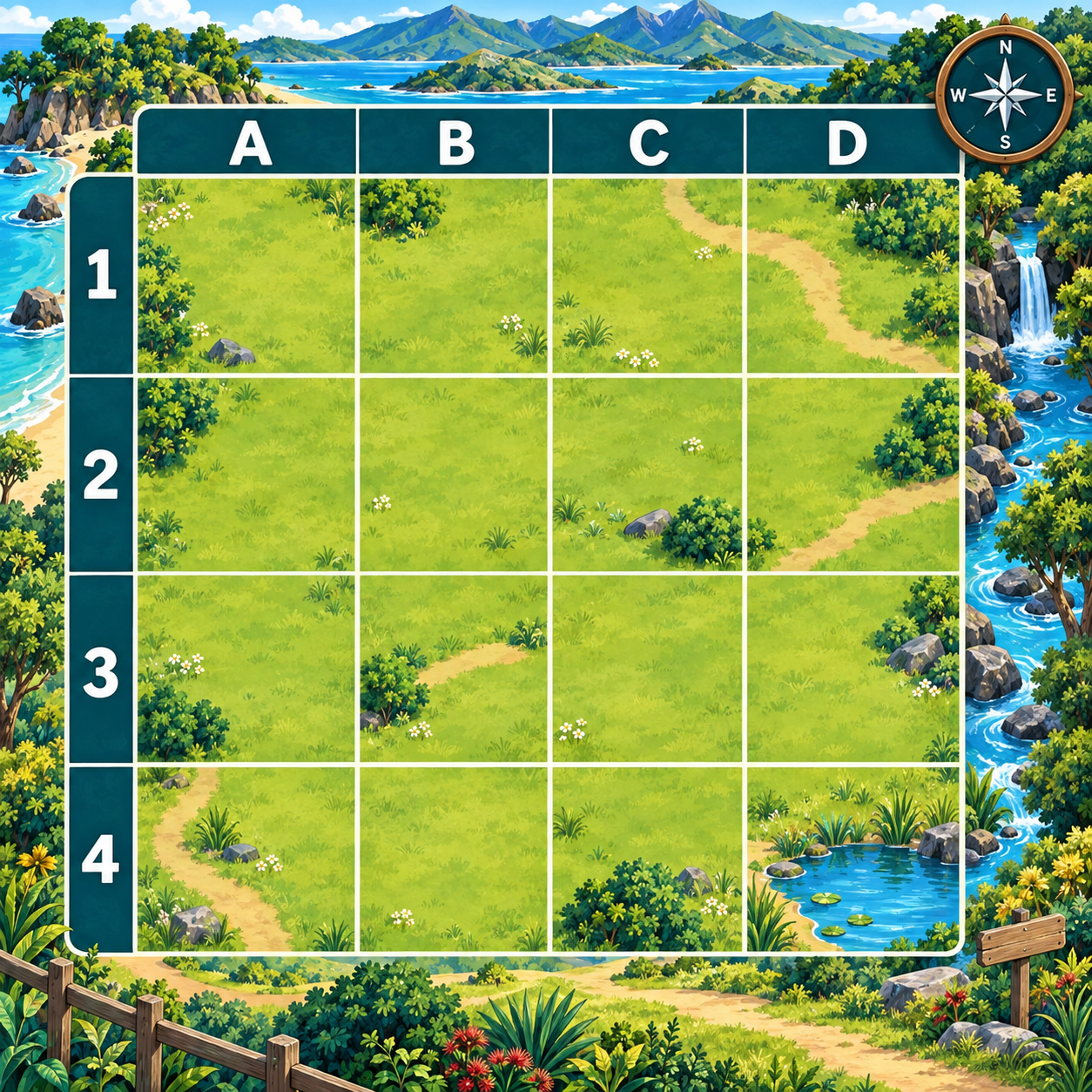
Guide Koru the robot across the illustrated map one square at a time. Record where Koru travels, then tell the whole journey.
1START → MARAEREADY
2MARAE → FINISHLOCKED
3WHOLE JOURNEYLOCKED
KORU'S LOCAL HISTORY MAP
PART 1
START TO MARAE
Move Koru the robot from to the marae.
2. Move Koru one square at a timeUse the compass buttons. Koru's coordinates and directions are recorded as you travel.

PART 2
MARAE TO FINISH
Now continue Koru's journey from the marae at to FINISH.
2. Move Koru from the marae to FINISHKeep using the compass. This route begins where Part 1 finished.
PART 3
TELL KORU'S WHOLE JOURNEY
Write 2–3 sentences explaining Koru's journey from START, to the marae, and then to FINISH. Include coordinates and some of the directions you used.
START → MARAE
MARAE → FINISH
Example: Koru started at and travelled to the marae at . Then Koru travelled from the marae to FINISH at . Koru moved north, east…
LOCAL HISTORY TRAIL · HIDDEN MOA
I see 9 moa, and you?
Look carefully through the historical timber trail. Tap each moa when you spot it. Some are hiding among the trees, logs, hut, cart and bridge.
MOA FOUND0 / 15
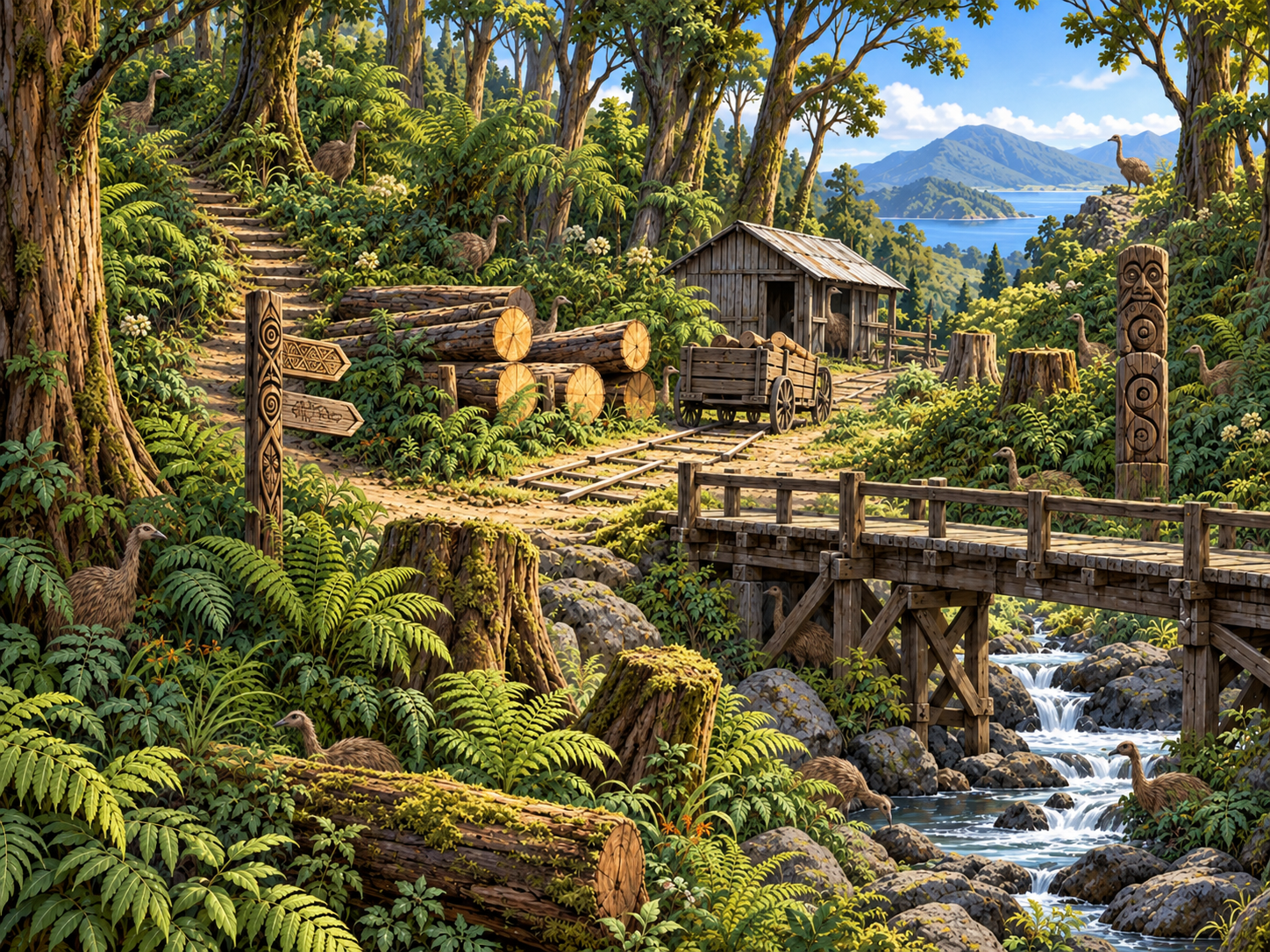
Look closely — some moa blend into the timber trail.