Our Vision
Make learning more accessible.
Interactive, game-like learning built around learning through doing.
My vision for Iconic Games is to make learning more accessible by building systems that are interactive, game-like, and based around learning through doing.
Two learning platforms
Mīharo Kura and Mīharo Ahau.
The two main platforms I want to build are Mīharo Kura and Mīharo Ahau.
Mīharo Kura is for curriculum-aligned education and school support. Mīharo Ahau is for self-development and learning beyond school.
I don't want learning to just mean sitting there reading information or watching someone else do something. I want people to actually interact with what they're learning.
Mīharo Kura
Support for school, homework and qualifications.
Mīharo Kura is curriculum-aligned and designed to support what students are already learning at school.
That could mean helping with homework, catching up on something you don't understand, practising before a test, working towards NCEA, or whatever New Zealand's qualification system looks like in the future.
The platform should keep up with curriculum changes so teachers and students don't have to constantly work out what has changed and how they're supposed to keep up with it.
Teachers are already overworked and underpaid, and they're expected to keep up with an ever-changing curriculum without always being given the time or tools to do it properly.
I want Mīharo Kura to help with that.
It isn't there to replace teachers. It's there to support them.
And it's there for the student who genuinely wants to pass but is struggling to keep up, doesn't understand the way something has been taught, or just needs another way of learning it.
Mīharo Ahau
Learning beyond school.
Mīharo Ahau is about self-development and learning beyond school.
It should be able to support you with whatever you're trying to learn.
You might be studying towards a law qualification through Open Polytechnic. You might be doing an apprenticeship. You might be learning the theory for a trade. You might be studying for your driver's licence or truck licence.
You might want to learn how to cook, weld, build a computer, produce a music track, design clothing, run a business, or learn something completely different.
There aren't really limits on what it could become.
If there is something to learn, I want to find a way to make that learning more interactive and easier to engage with.
Learning in a different way
Turn theory into something people can engage with.
A lot of learning still relies heavily on reading, writing and memorising information.
That works for some people. For others, it really doesn't.
I've had the opportunity to support people in my own whānau who struggle with that kind of learning, and I've seen the difference it can make when you take something that would normally be pages of reading and memorising and turn it into something interactive and engaging.
They engage with it. They understand it. And most importantly, the learning actually sticks.
That's what I want to build into these platforms.
Designed for equity
Build for the people who are being missed.
The biggest part of this vision is equity.
I want to build for the people who are being missed.
People with dyslexia, ADHD, learning disabilities, behavioural challenges, difficulties with reading or writing, things happening at home, mental health barriers, financial barriers, location barriers, or anything else that makes learning harder to access.
I want to remove as many of those barriers as I can.
That doesn't mean doing the work for someone.
My dream is to open the door. You're still the one who has to walk through it.
I want to help people help themselves.
Give them access. Give them the tools. Give them another way to learn. Then let them decide what they do with that opportunity.
Where this could go
Mobile and computer first. Much bigger over time.
The first versions of Mīharo Kura and Mīharo Ahau will most likely be built for mobile and computer.
Long term, I want to take it much further.
With technology like VR, you could eventually learn practical skills in simulated environments before needing access to expensive equipment, tools or materials.
You could learn anything from cooking to welding, producing music, building a computer, learning a trade, designing something or practising a completely new skill.
That makes learning more accessible, but it can also make it more financially and environmentally sustainable.
There is less waste. Less reliance on having access to expensive equipment just to get started. And more opportunity for people to learn regardless of where they live or what resources they already have.
There are no limits on what learning has to look like.
If you have the idea, we want to make it a reality.
That's what I'm trying to build with Iconic Games.
A future physical home
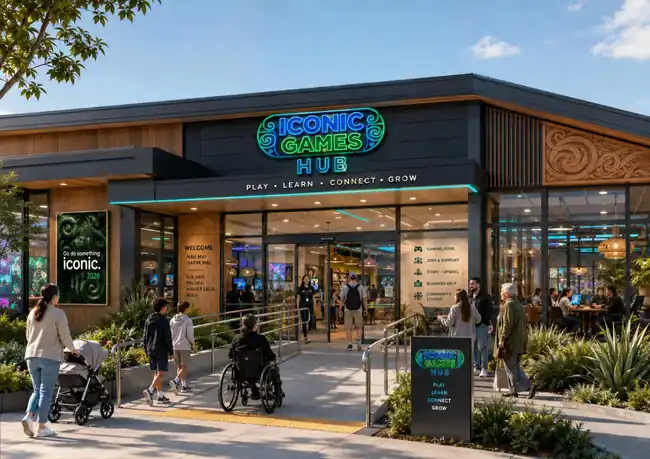
The Iconic Games Hub.
The original arcade idea has never disappeared completely. Long term, the vision still includes the possibility of a physical Iconic Games Hub — part arcade, part learning space, part technology and community experience.