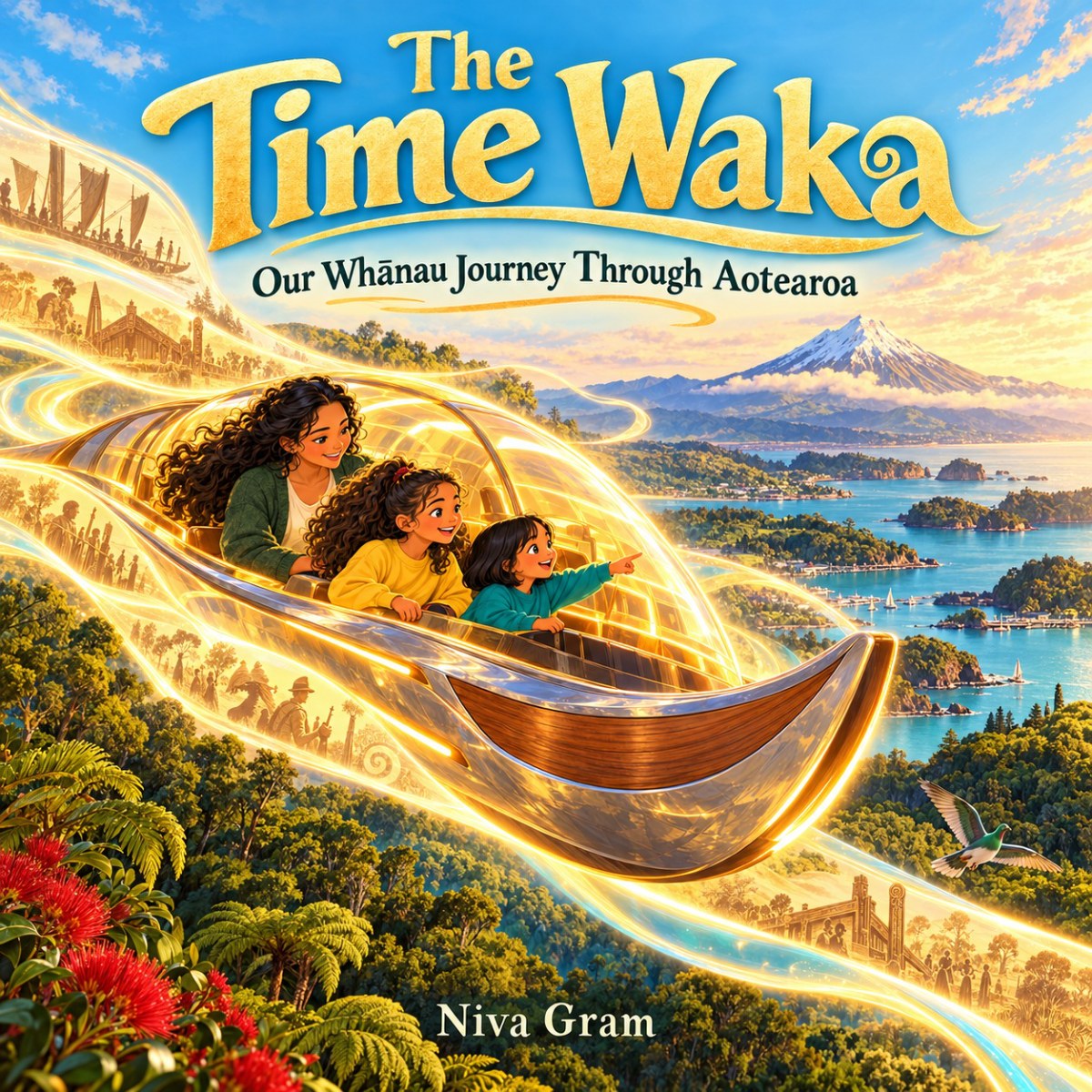
The Time Waka
Our Whānau Journey Through Aotearoa · By Niva Gram
Page 1 of 32
Accessible text
The Time Waka
Our Whānau Journey Through Aotearoa
Niva Gram
Accessible text
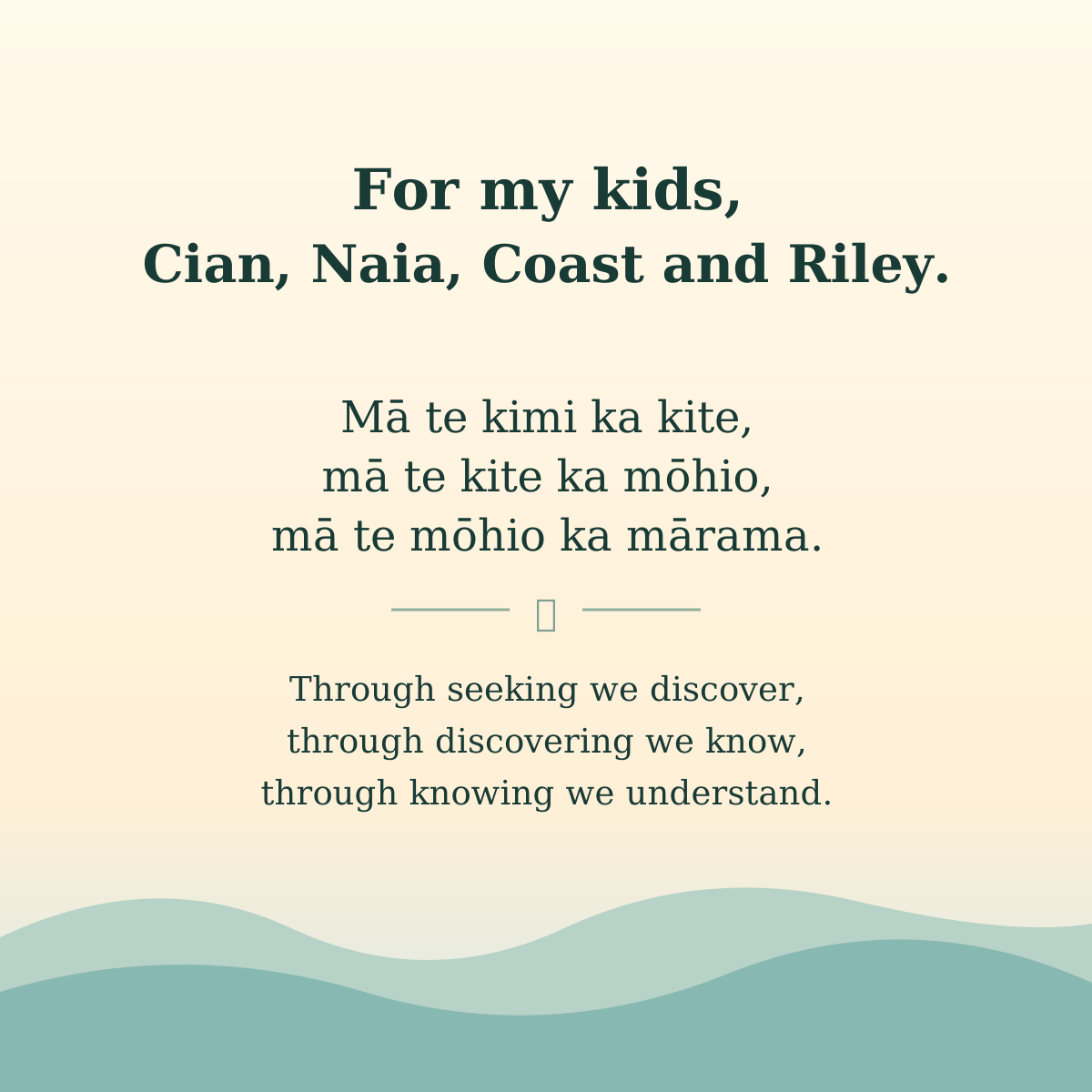
For my kids, Cian, Naia, Coast and Riley. Mā te kimi ka kite, mā te kite ka mōhio, mā te mōhio ka mārama. Through seeking we discover, through discovering we know, through knowing we understand.
Accessible text
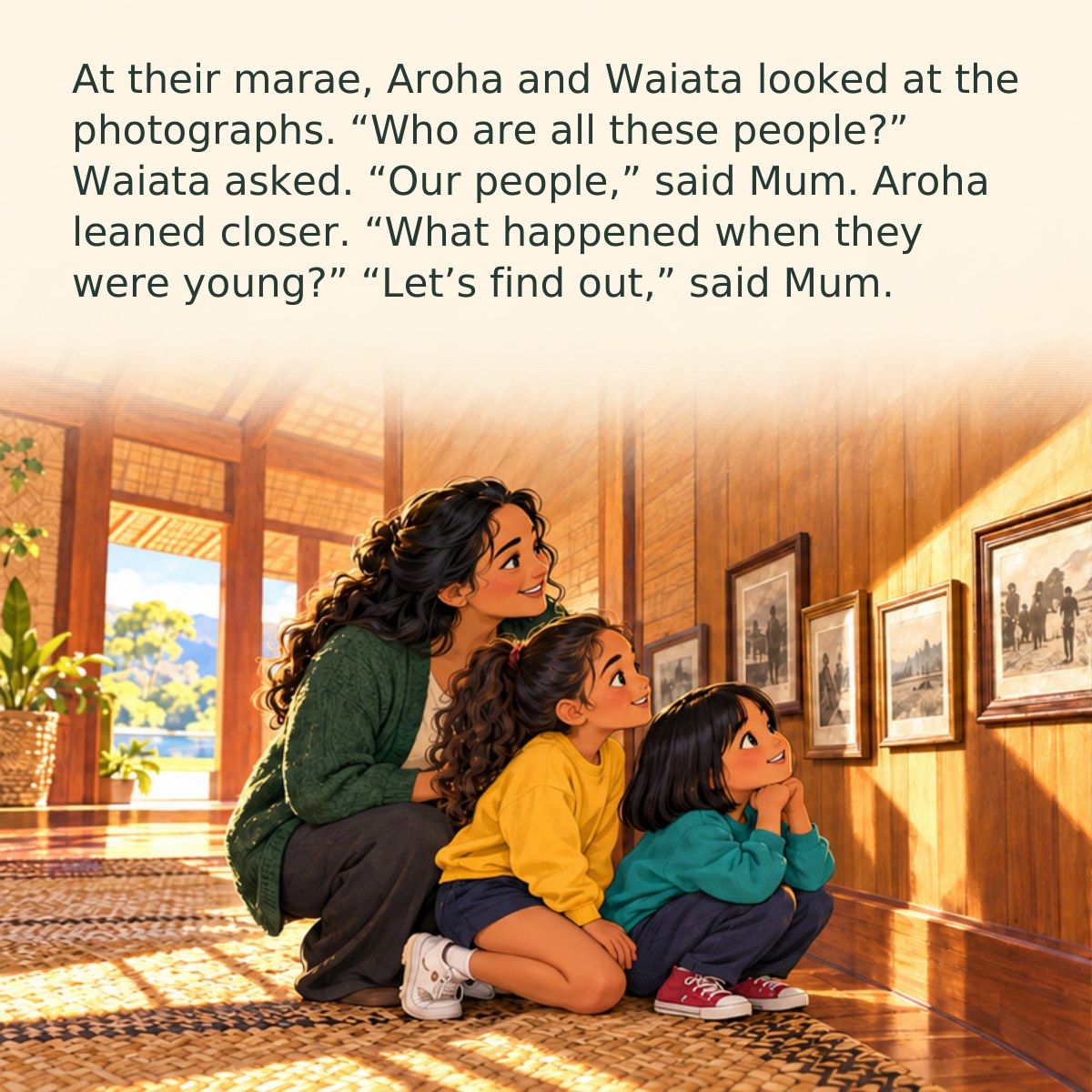
At their marae, Aroha and Waiata looked at the photographs. “Who are all these people?” Waiata asked. “Our people,” said Mum. Aroha leaned closer. “What happened when they were young?” “Let’s find out,” said Mum.
Accessible text
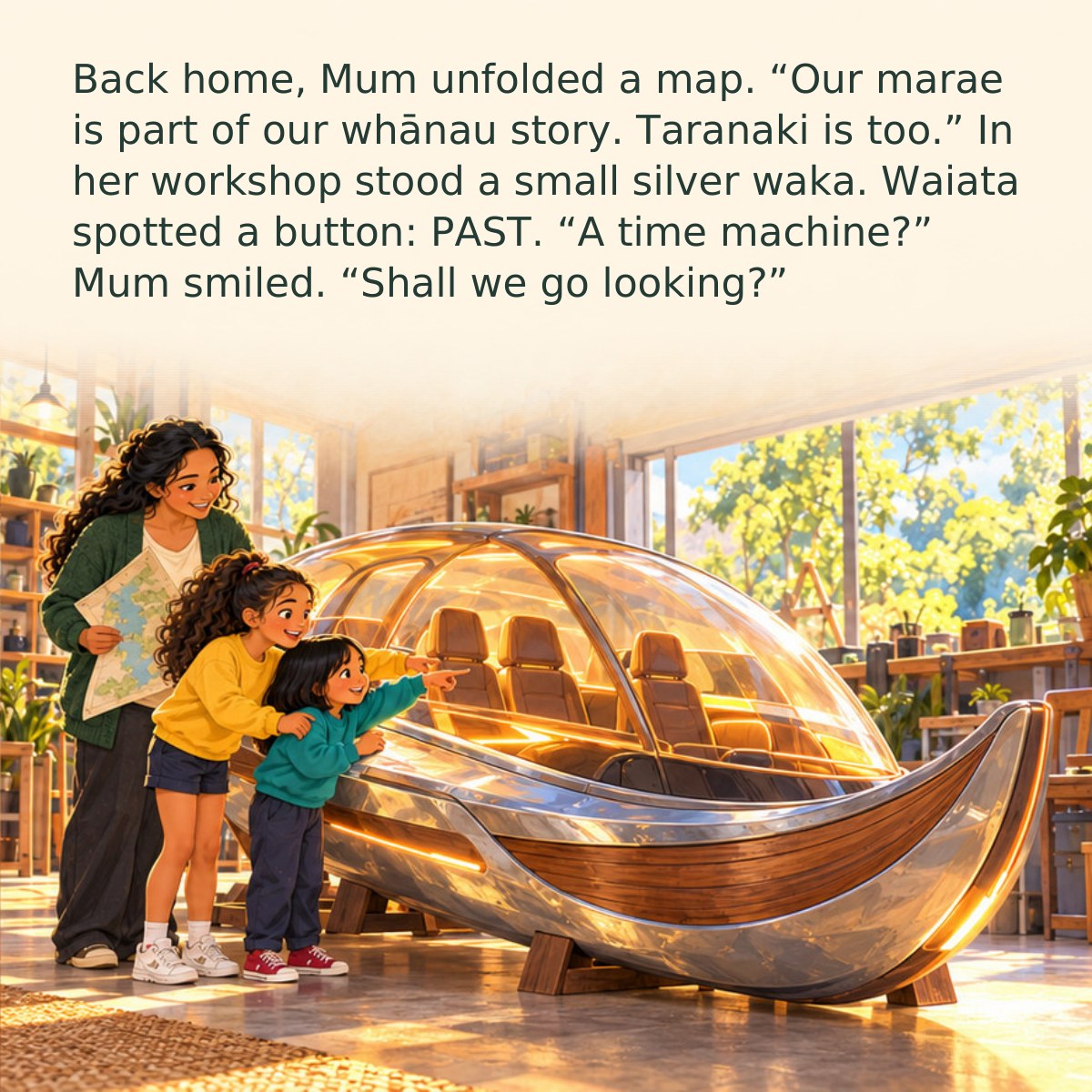
Back home, Mum unfolded a map. “Our marae is part of our whānau story. Taranaki is too.” In her workshop stood a small silver waka. Waiata spotted a button: PAST. “A time machine?” Mum smiled. “Shall we go looking?”
Accessible text
WHOOSH! The city roads disappeared. Waka moved across the water. People tended gardens, gathered kai and worked together. “This was already home,” said Mum. Aroha watched someone carefully mend a fishing net. “There is so much happening!”
Accessible text
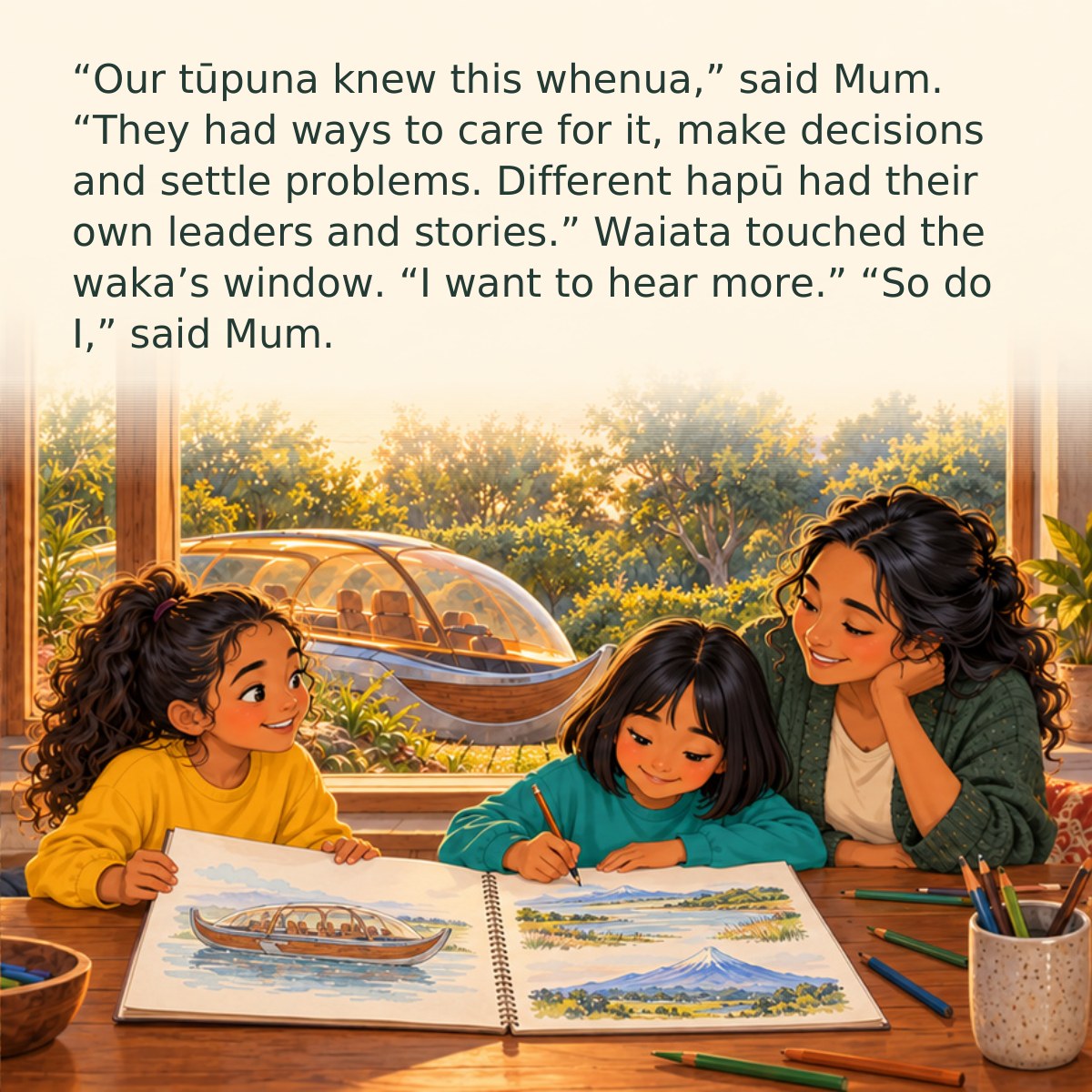
“Our tūpuna knew this whenua,” said Mum. “They had ways to care for it, make decisions and settle problems. Different hapū had their own leaders and stories.” Waiata touched the waka’s window. “I want to hear more.” “So do I,” said Mum.
Accessible text
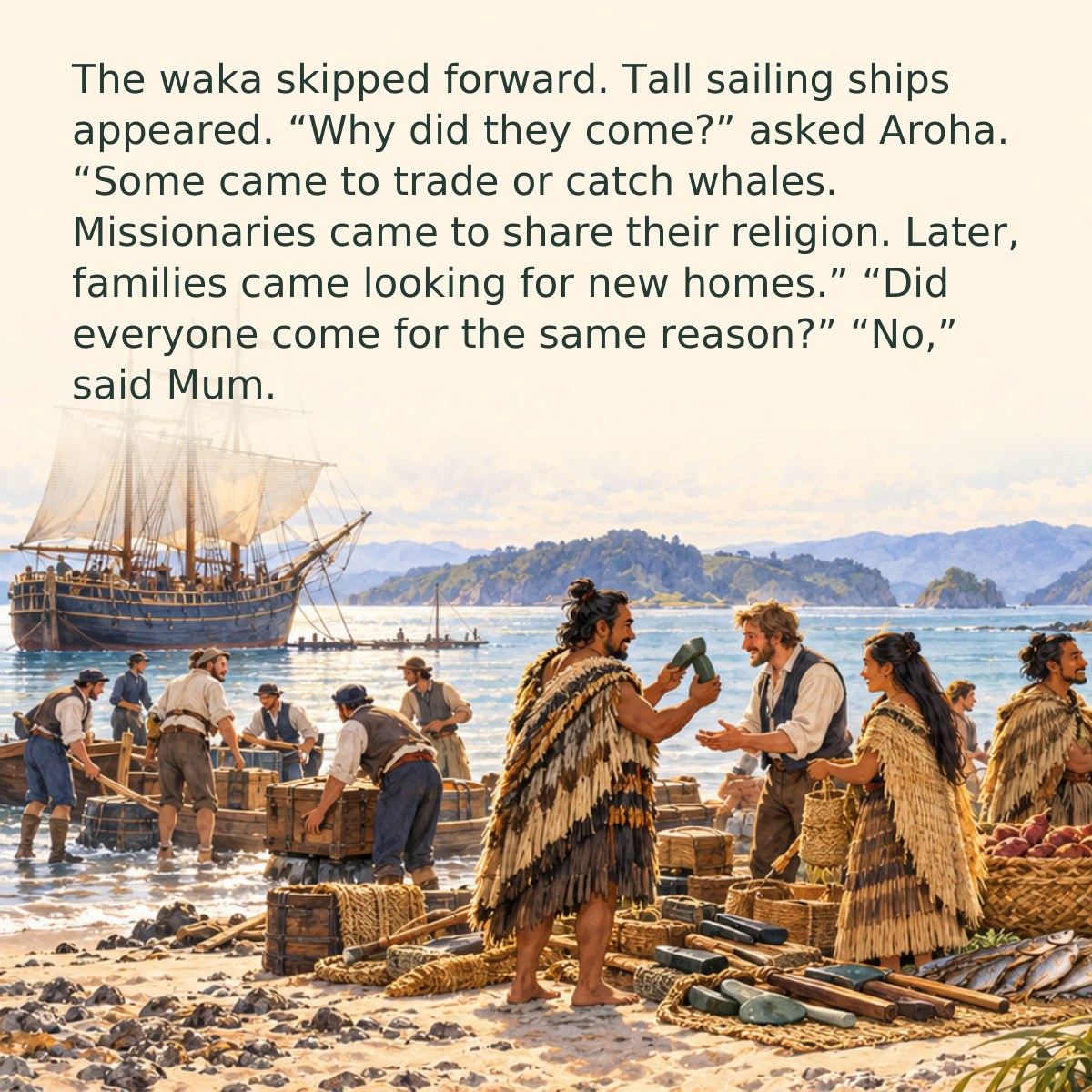
The waka skipped forward. Tall sailing ships appeared. “Why did they come?” asked Aroha. “Some came to trade or catch whales. Missionaries came to share their religion. Later, families came looking for new homes.” “Did everyone come for the same reason?” “No,” said Mum.
Accessible text
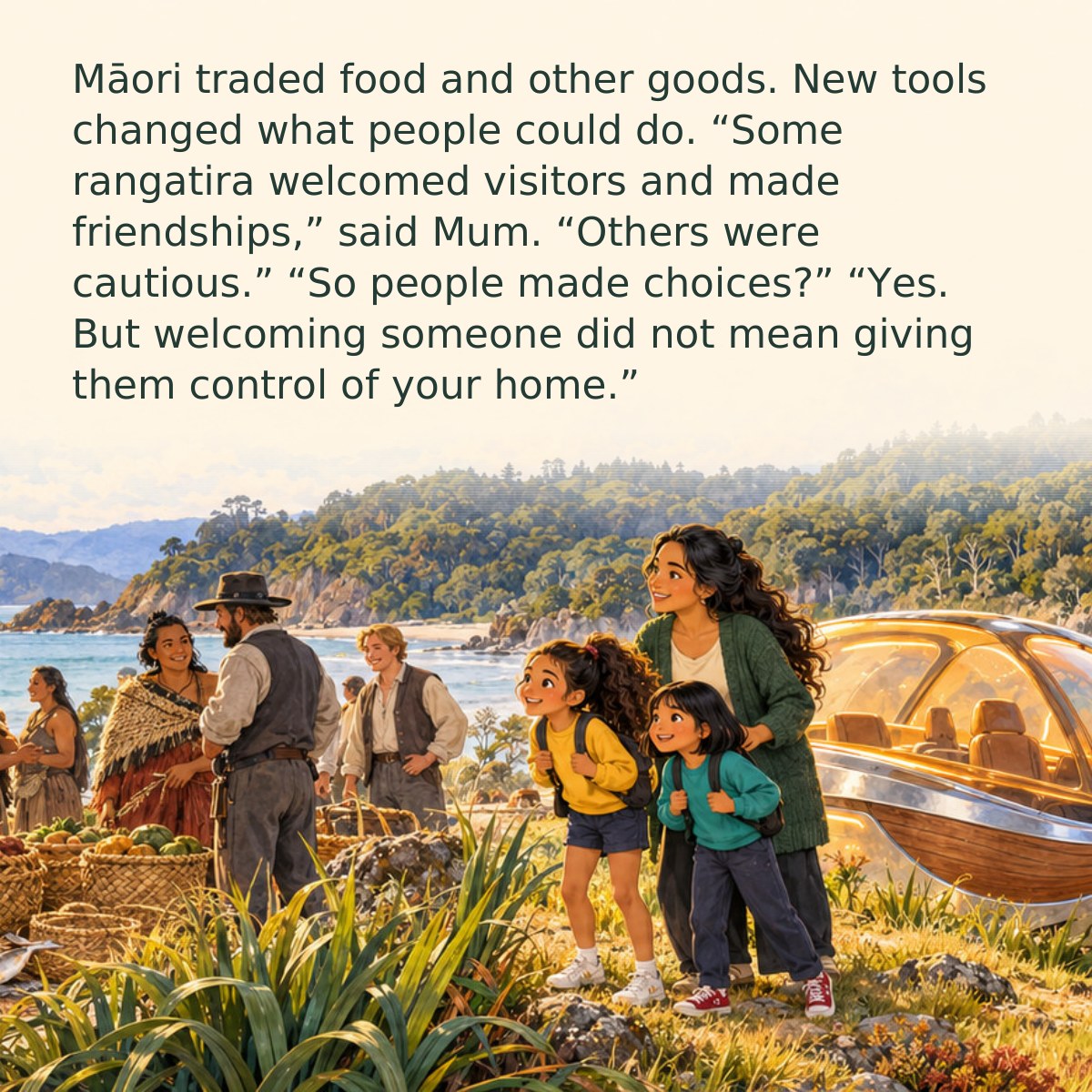
Māori traded food and other goods. New tools changed what people could do. “Some rangatira welcomed visitors and made friendships,” said Mum. “Others were cautious.” “So people made choices?” “Yes. But welcoming someone did not mean giving them control of your home.”
Accessible text
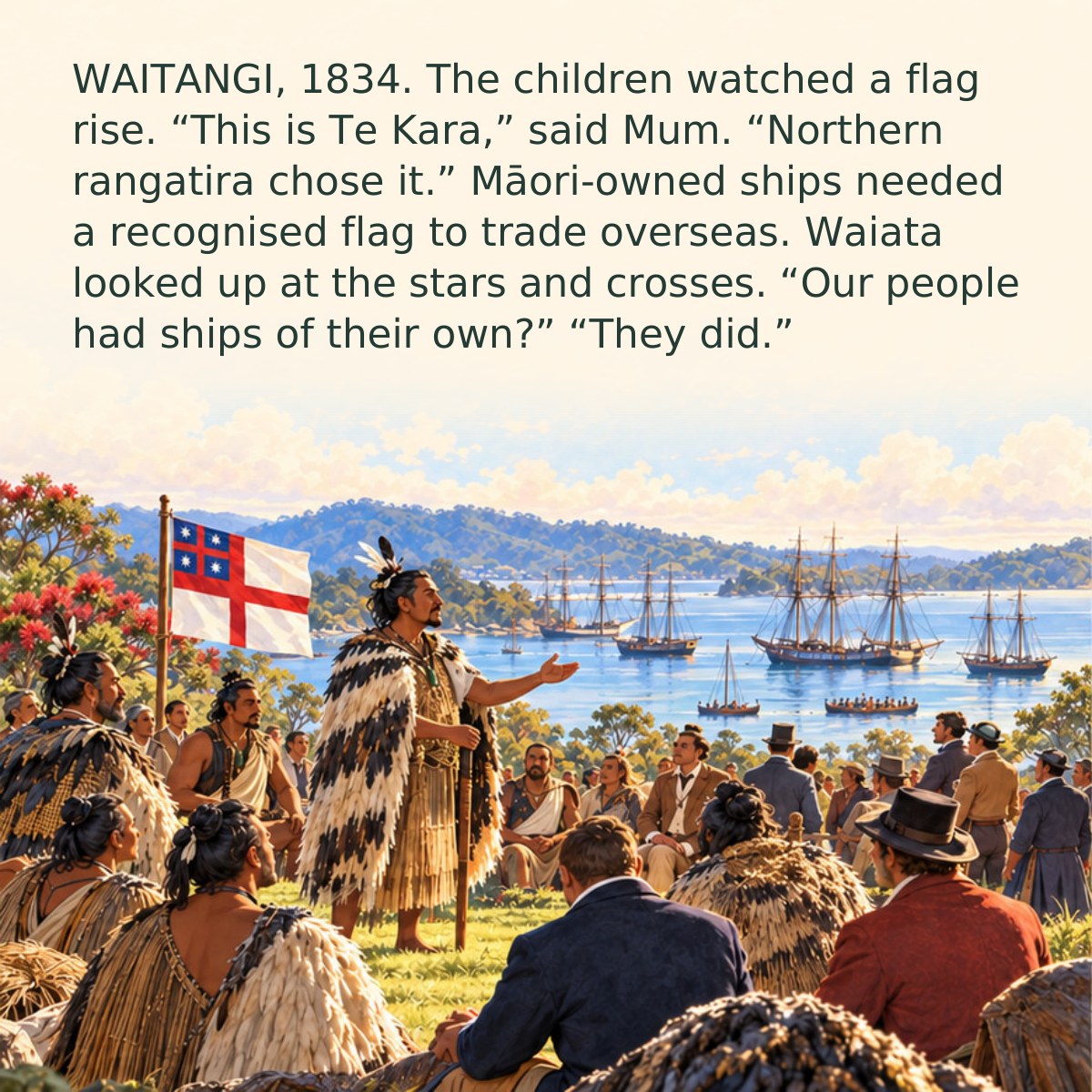
WAITANGI, 1834. The children watched a flag rise. “This is Te Kara,” said Mum. “Northern rangatira chose it.” Māori-owned ships needed a recognised flag to trade overseas. Waiata looked up at the stars and crosses. “Our people had ships of their own?” “They did.”
Accessible text
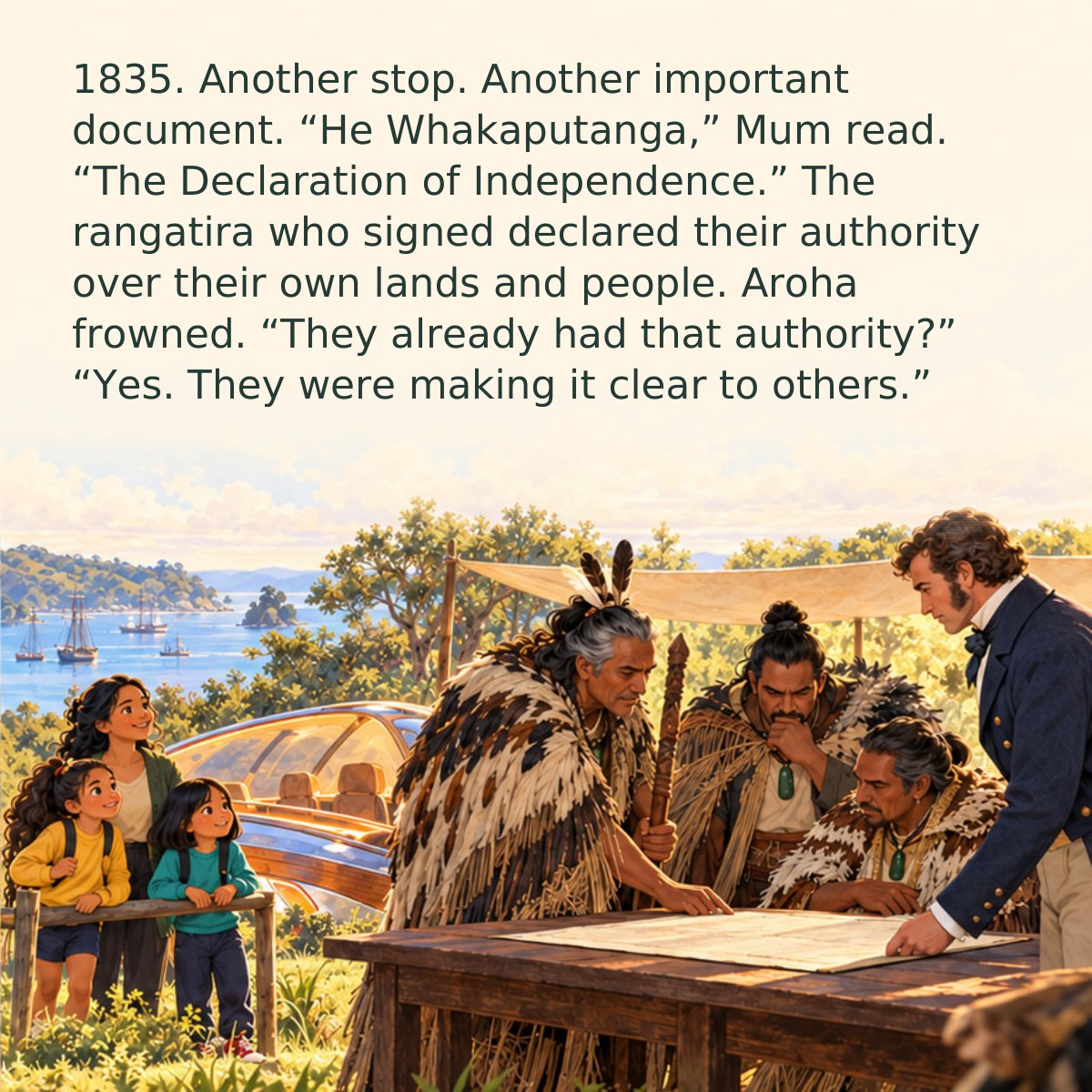
1835. Another stop. Another important document. “He Whakaputanga,” Mum read. “The Declaration of Independence.” The rangatira who signed declared their authority over their own lands and people. Aroha frowned. “They already had that authority?” “Yes. They were making it clear to others.”
Accessible text
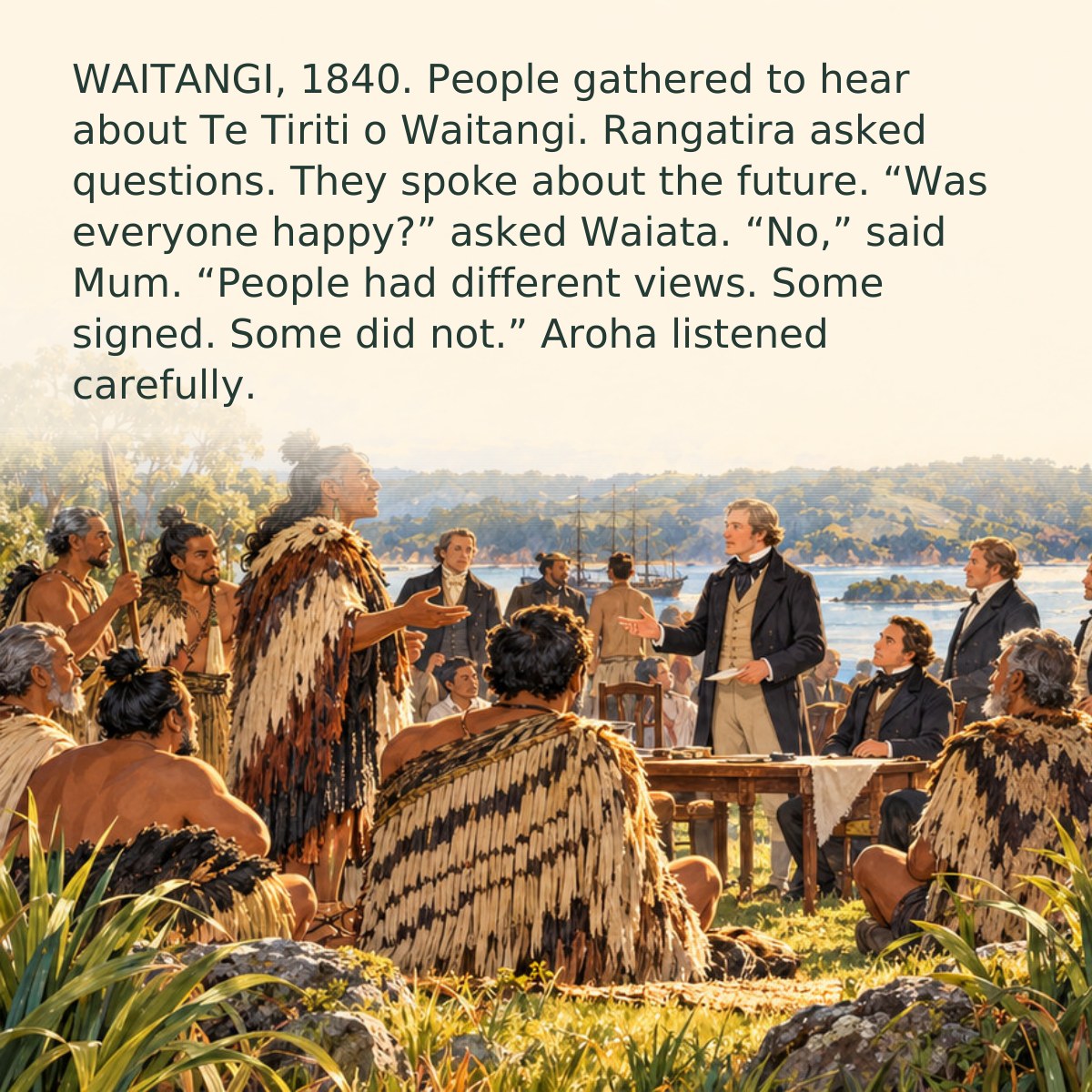
WAITANGI, 1840. People gathered to hear about Te Tiriti o Waitangi. Rangatira asked questions. They spoke about the future. “Was everyone happy?” asked Waiata. “No,” said Mum. “People had different views. Some signed. Some did not.” Aroha listened carefully.
Accessible text
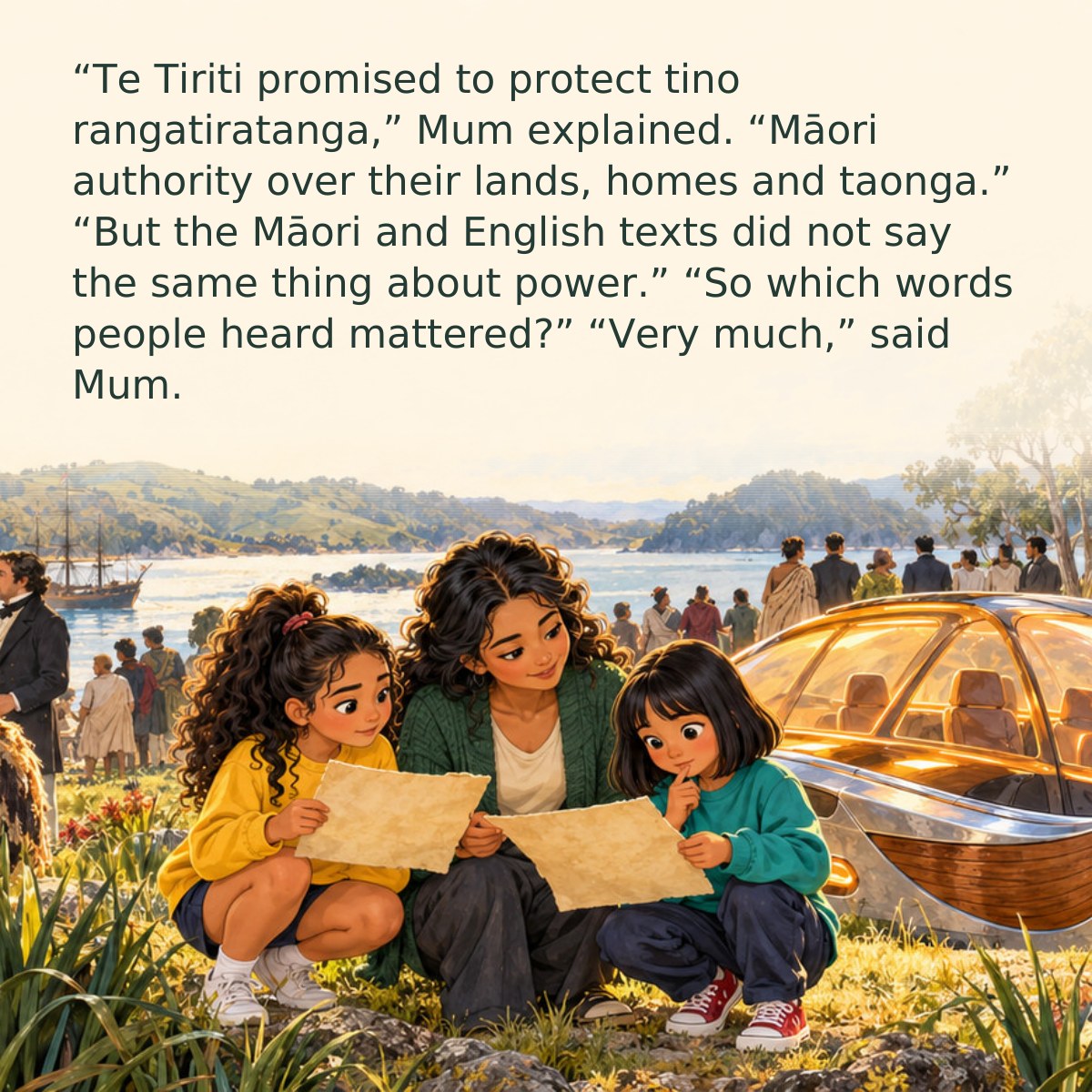
“Te Tiriti promised to protect tino rangatiratanga,” Mum explained. “Māori authority over their lands, homes and taonga.” “But the Māori and English texts did not say the same thing about power.” “So which words people heard mattered?” “Very much,” said Mum.
Accessible text
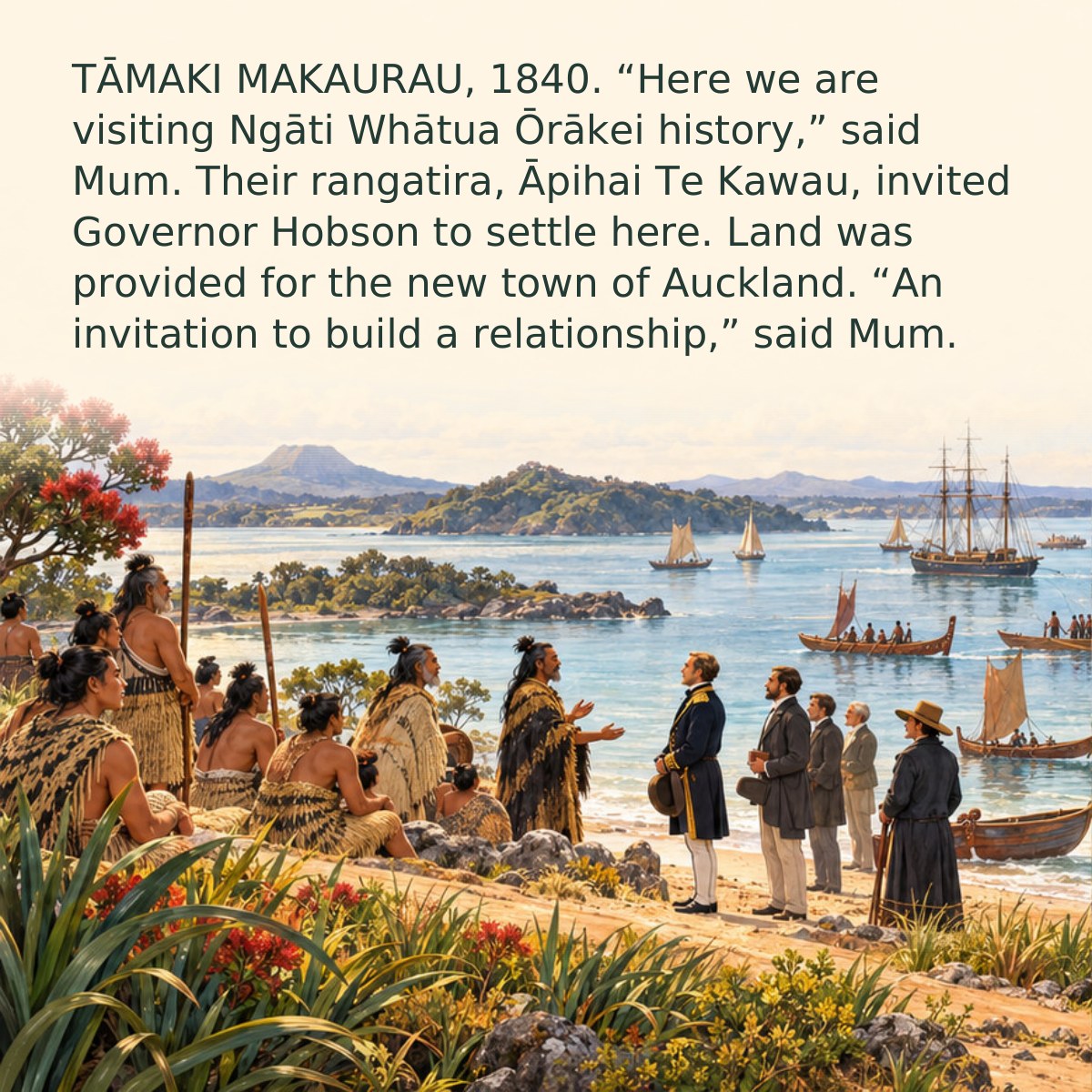
TĀMAKI MAKAURAU, 1840. “Here we are visiting Ngāti Whātua Ōrākei history,” said Mum. Their rangatira, Āpihai Te Kawau, invited Governor Hobson to settle here. Land was provided for the new town of Auckland. “An invitation to build a relationship,” said Mum.
Accessible text
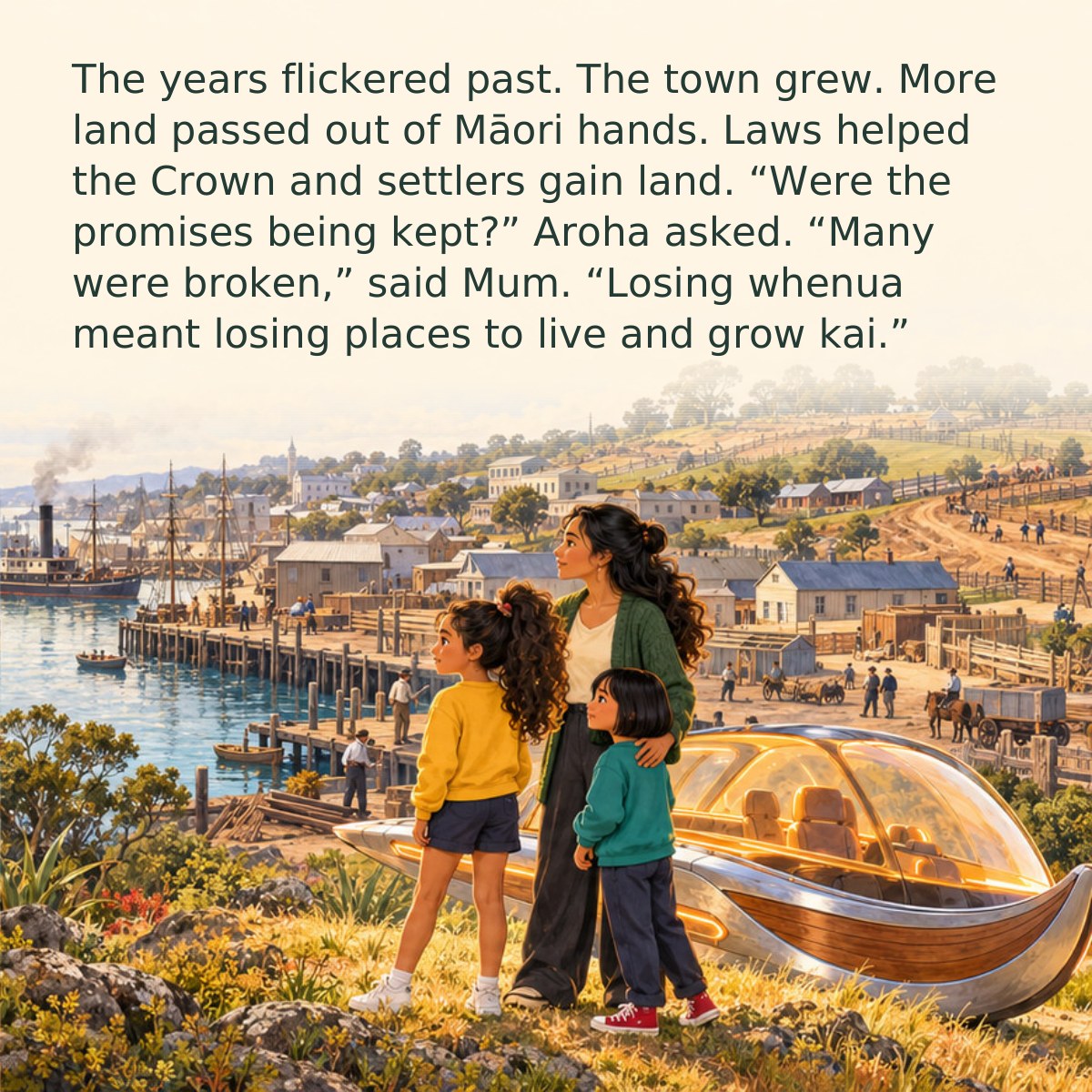
The years flickered past. The town grew. More land passed out of Māori hands. Laws helped the Crown and settlers gain land. “Were the promises being kept?” Aroha asked. “Many were broken,” said Mum. “Losing whenua meant losing places to live and grow kai.”
Accessible text
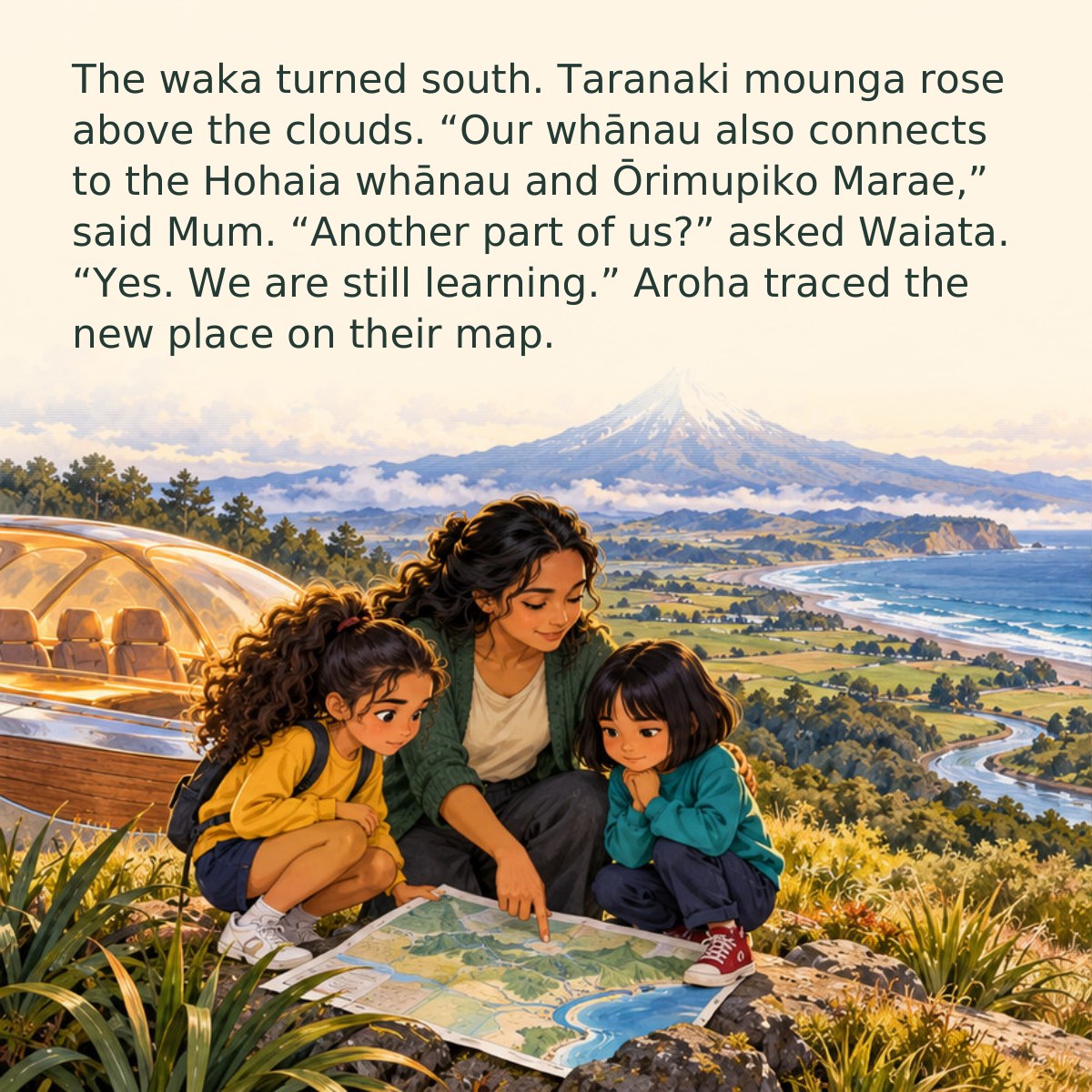
The waka turned south. Taranaki mounga rose above the clouds. “Our whānau also connects to the Hohaia whānau and Ōrimupiko Marae,” said Mum. “Another part of us?” asked Waiata. “Yes. We are still learning.” Aroha traced the new place on their map.
Accessible text
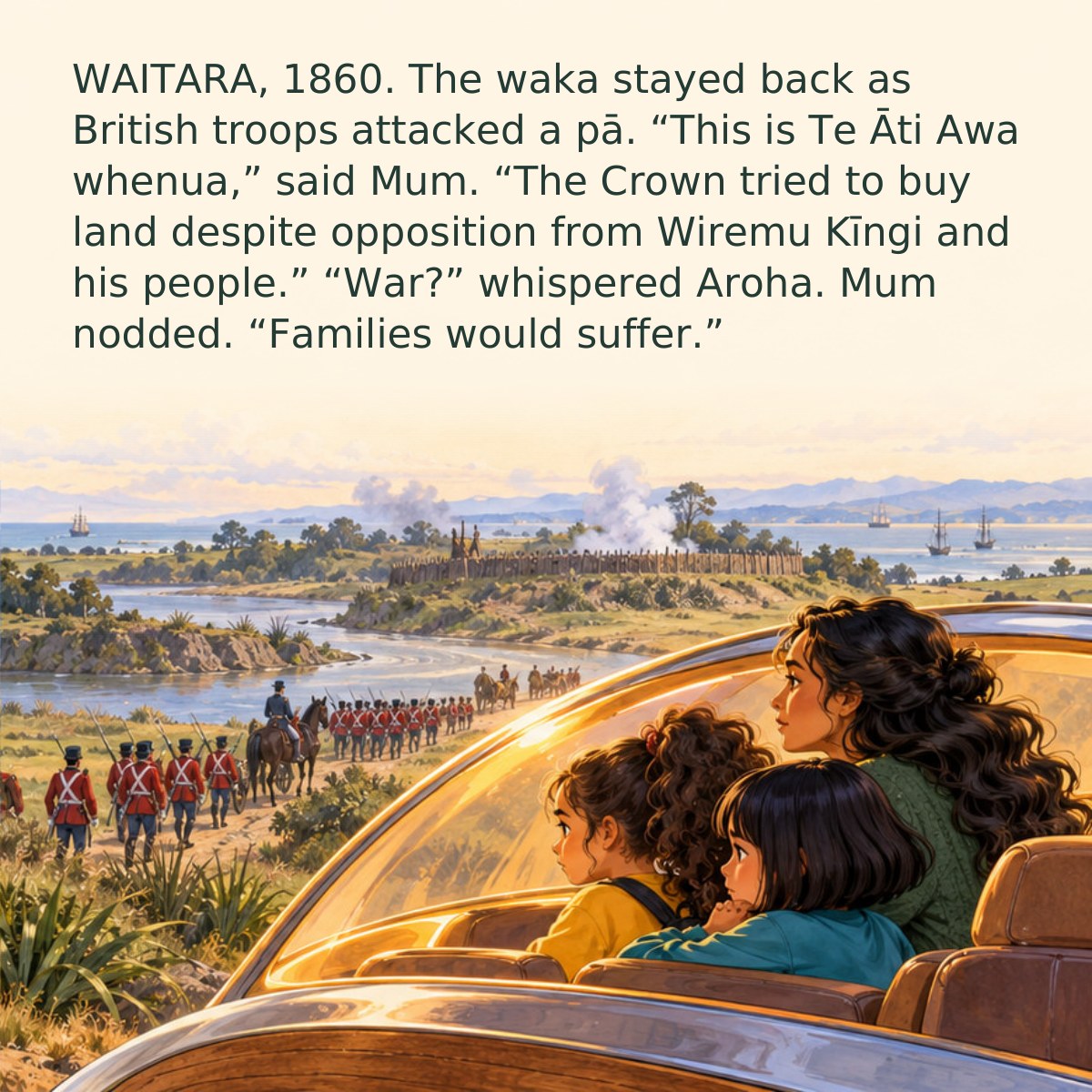
WAITARA, 1860. The waka stayed back as British troops attacked a pā. “This is Te Āti Awa whenua,” said Mum. “The Crown tried to buy land despite opposition from Wiremu Kīngi and his people.” “War?” whispered Aroha. Mum nodded. “Families would suffer.”
Accessible text
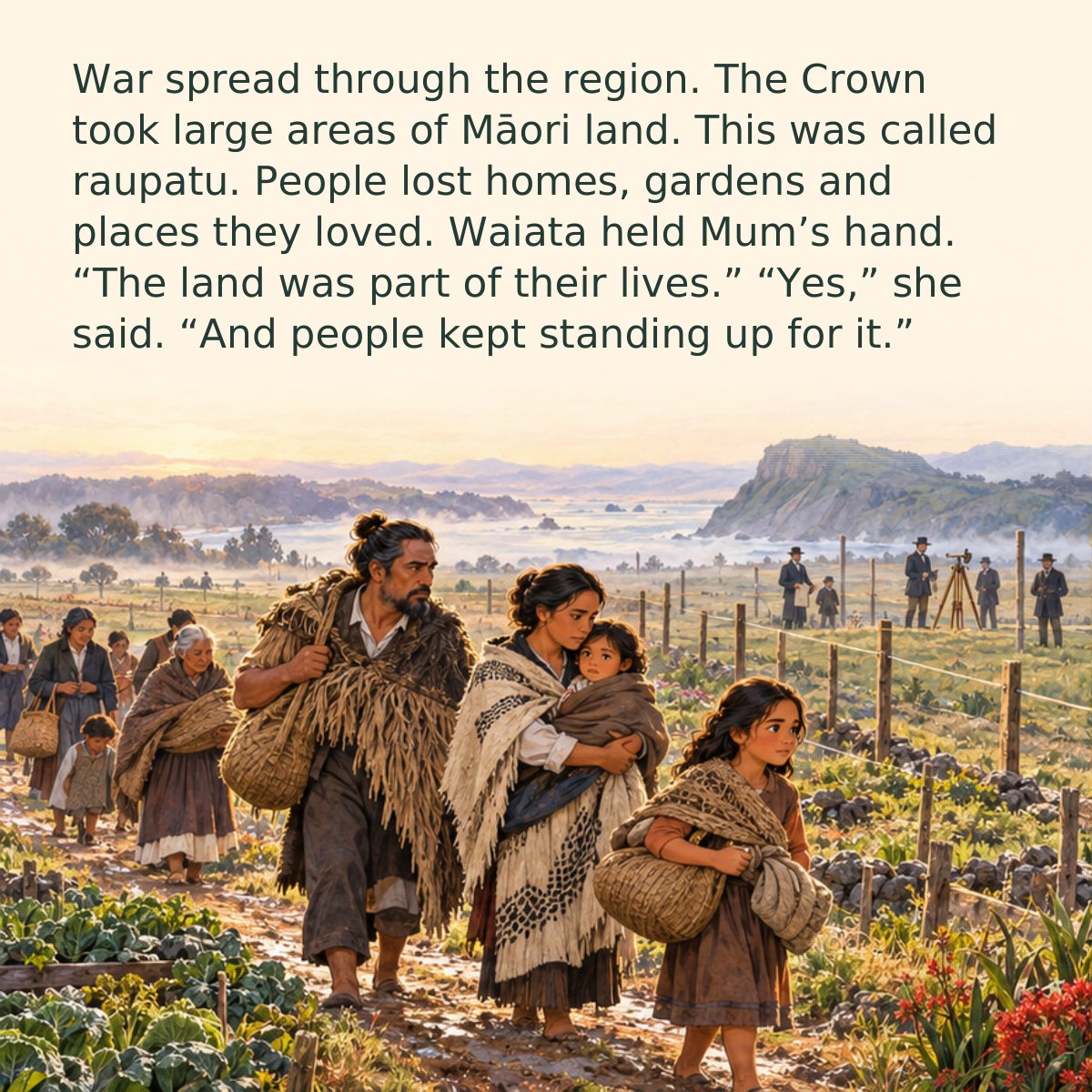
War spread through the region. The Crown took large areas of Māori land. This was called raupatu. People lost homes, gardens and places they loved. Waiata held Mum’s hand. “The land was part of their lives.” “Yes,” she said. “And people kept standing up for it.”
Accessible text
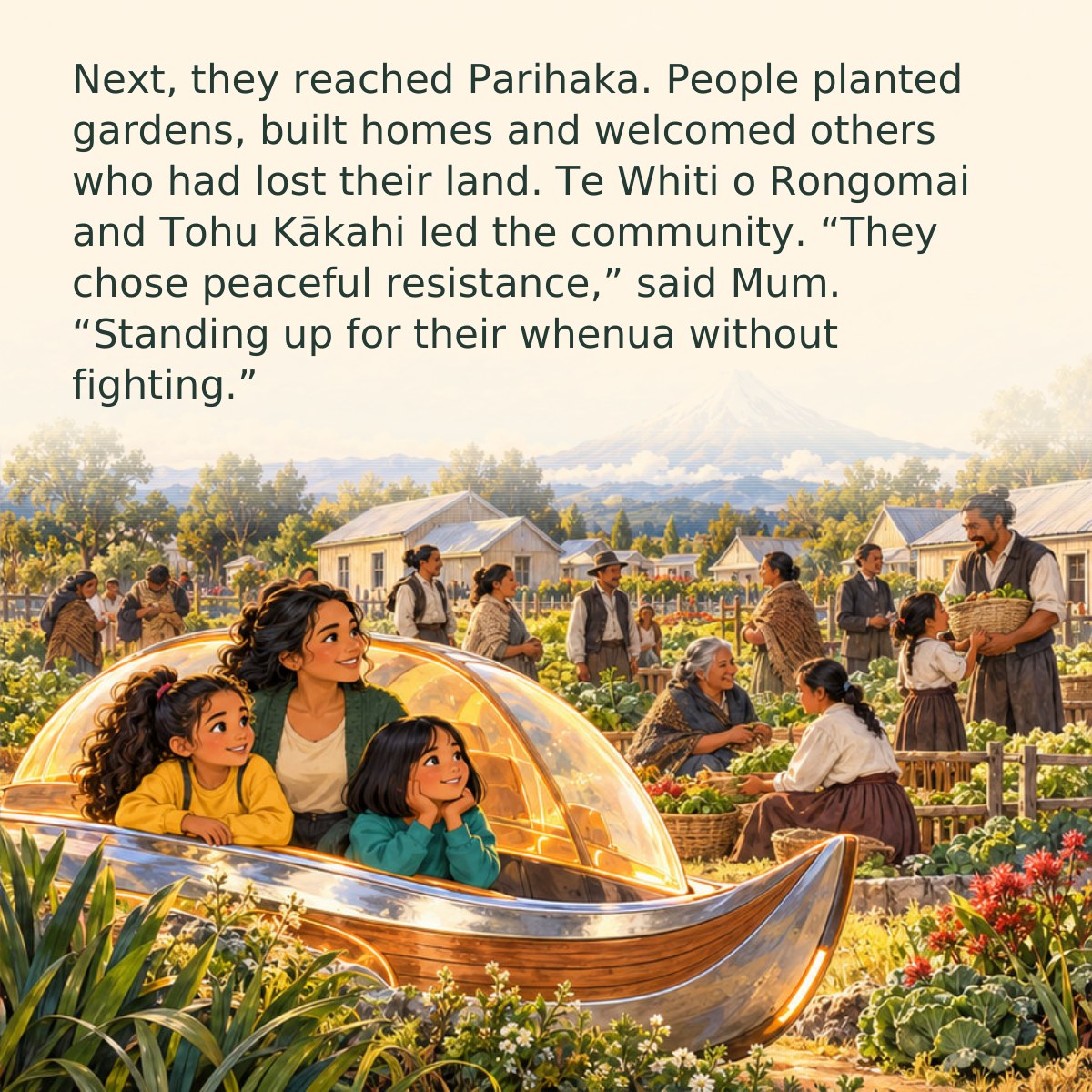
Next, they reached Parihaka. People planted gardens, built homes and welcomed others who had lost their land. Te Whiti o Rongomai and Tohu Kākahi led the community. “They chose peaceful resistance,” said Mum. “Standing up for their whenua without fighting.”
Accessible text
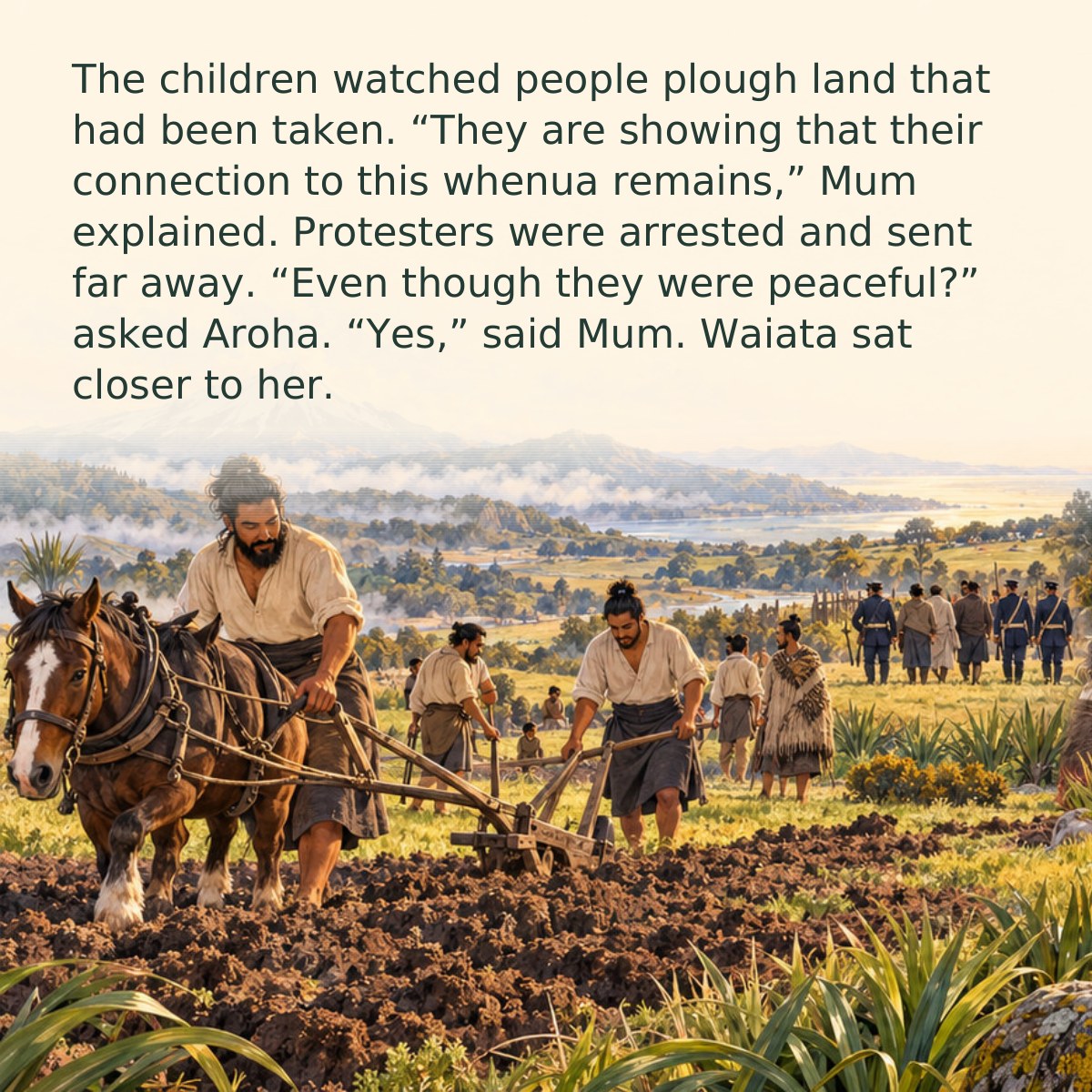
The children watched people plough land that had been taken. “They are showing that their connection to this whenua remains,” Mum explained. Protesters were arrested and sent far away. “Even though they were peaceful?” asked Aroha. “Yes,” said Mum. Waiata sat closer to her.
Accessible text
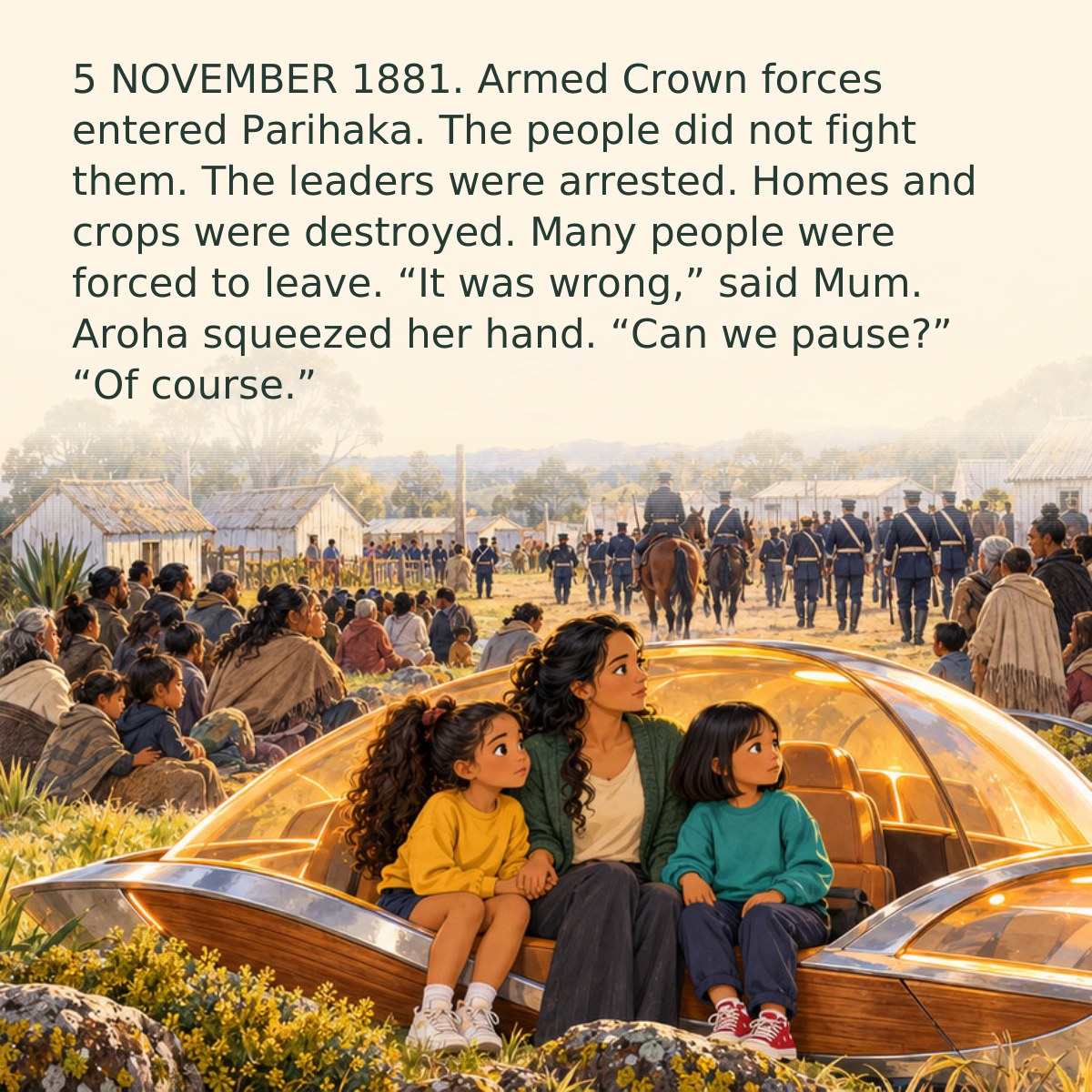
5 NOVEMBER 1881. Armed Crown forces entered Parihaka. The people did not fight them. The leaders were arrested. Homes and crops were destroyed. Many people were forced to leave. “It was wrong,” said Mum. Aroha squeezed her hand. “Can we pause?” “Of course.”
Accessible text
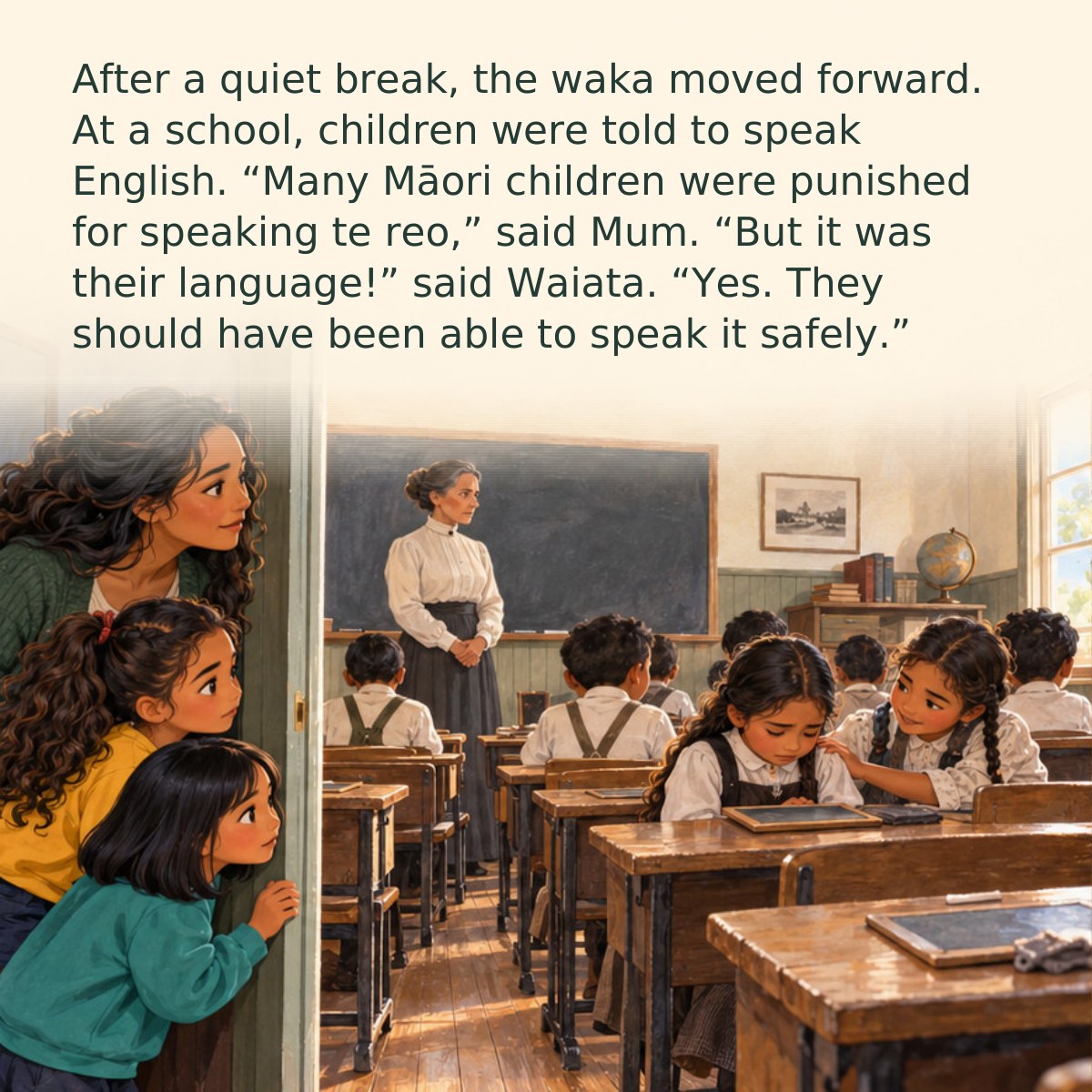
After a quiet break, the waka moved forward. At a school, children were told to speak English. “Many Māori children were punished for speaking te reo,” said Mum. “But it was their language!” said Waiata. “Yes. They should have been able to speak it safely.”
Accessible text
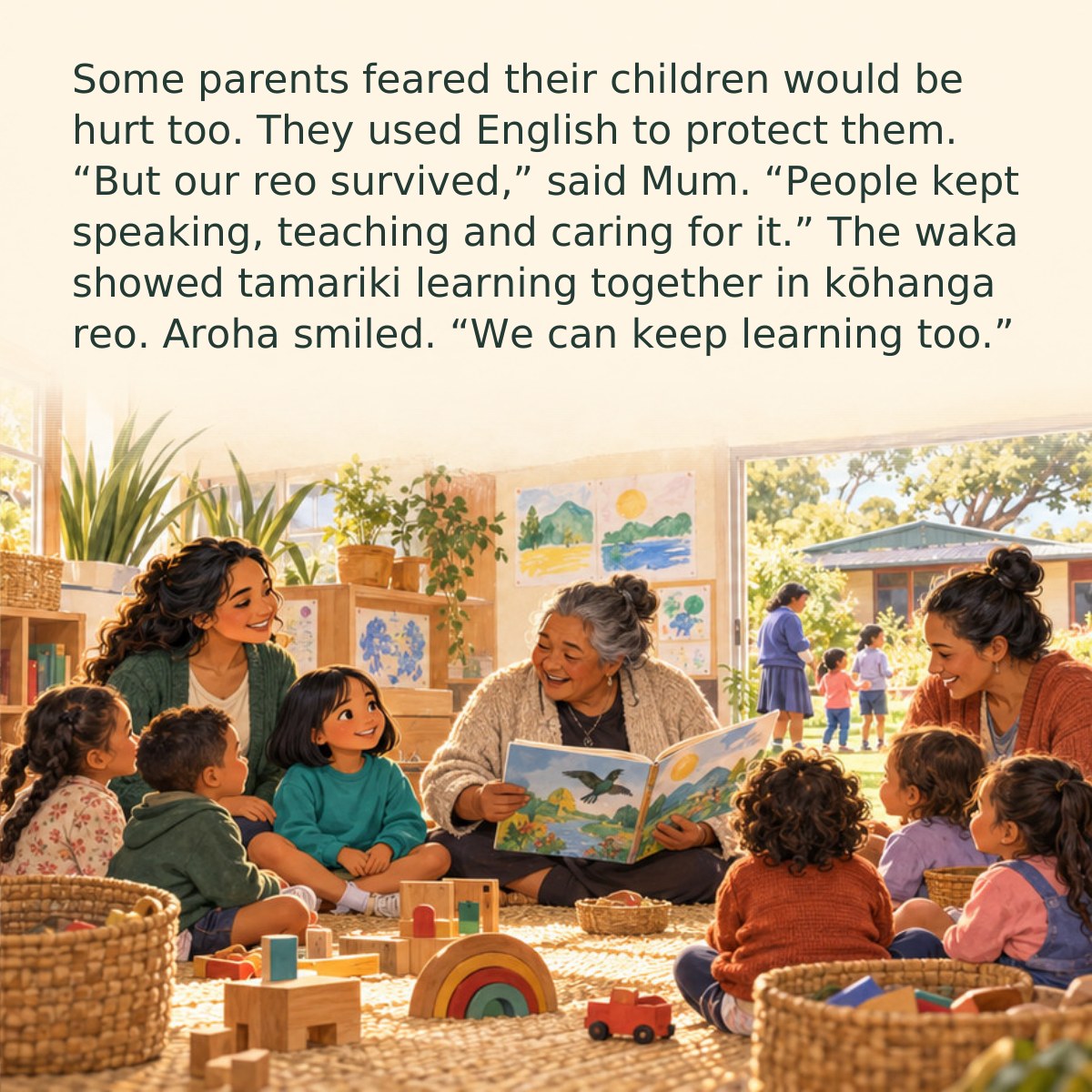
Some parents feared their children would be hurt too. They used English to protect them. “But our reo survived,” said Mum. “People kept speaking, teaching and caring for it.” The waka showed tamariki learning together in kōhanga reo. Aroha smiled. “We can keep learning too.”
Accessible text
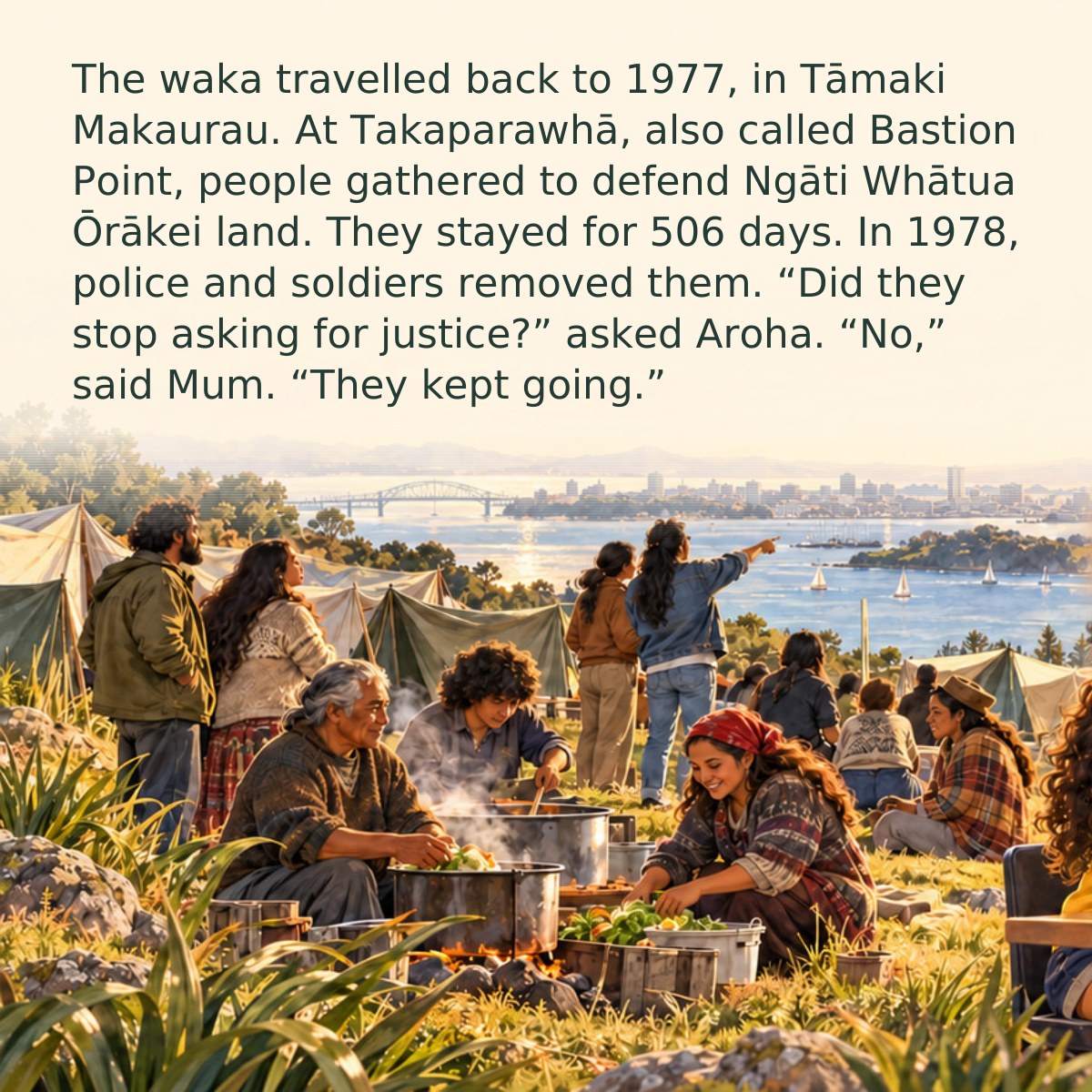
The waka travelled back to 1977, in Tāmaki Makaurau. At Takaparawhā, also called Bastion Point, people gathered to defend Ngāti Whātua Ōrākei land. They stayed for 506 days. In 1978, police and soldiers removed them. “Did they stop asking for justice?” asked Aroha. “No,” said Mum. “They kept going.”
Accessible text
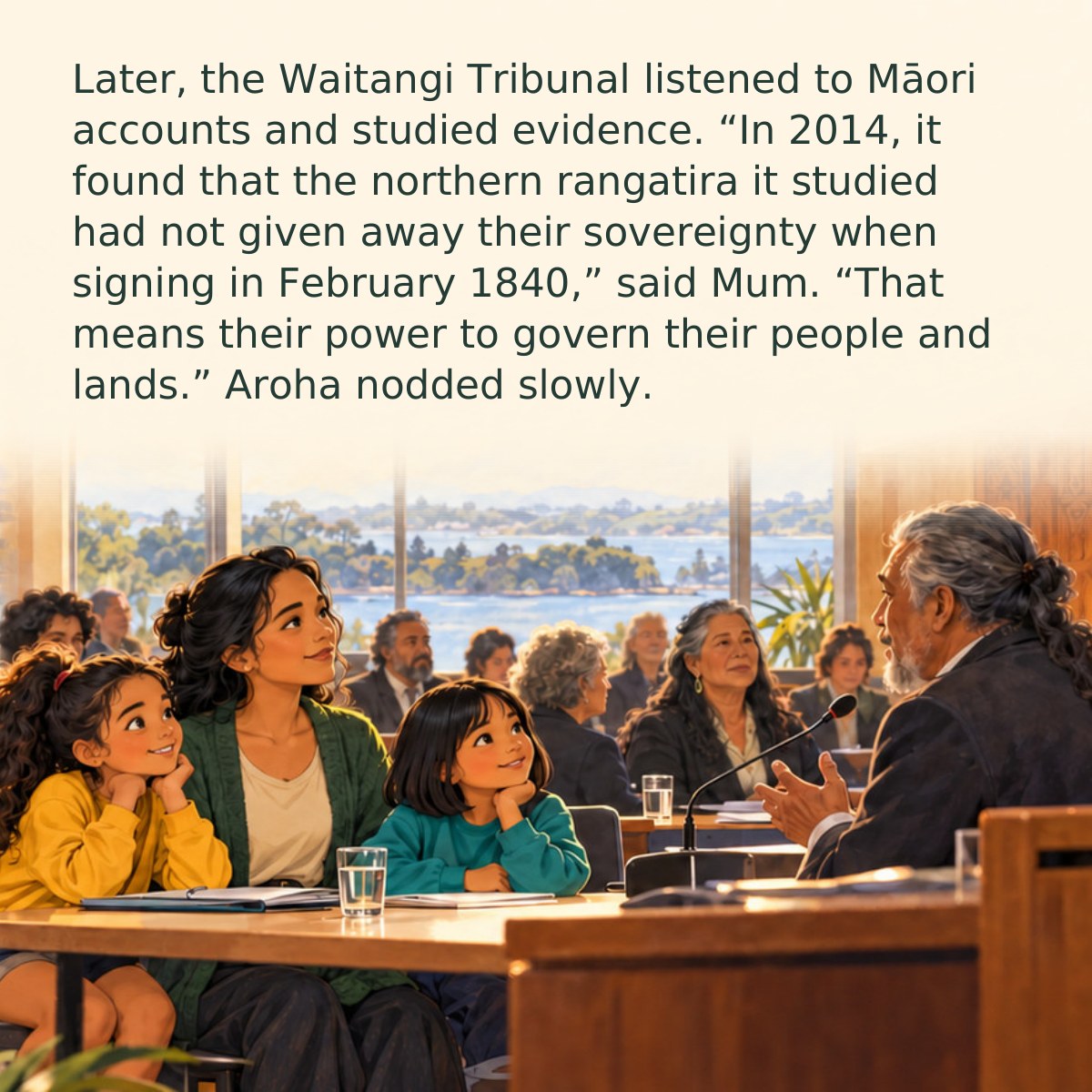
Later, the Waitangi Tribunal listened to Māori accounts and studied evidence. “In 2014, it found that the northern rangatira it studied had not given away their sovereignty when signing in February 1840,” said Mum. “That means their power to govern their people and lands.” Aroha nodded slowly.
Accessible text
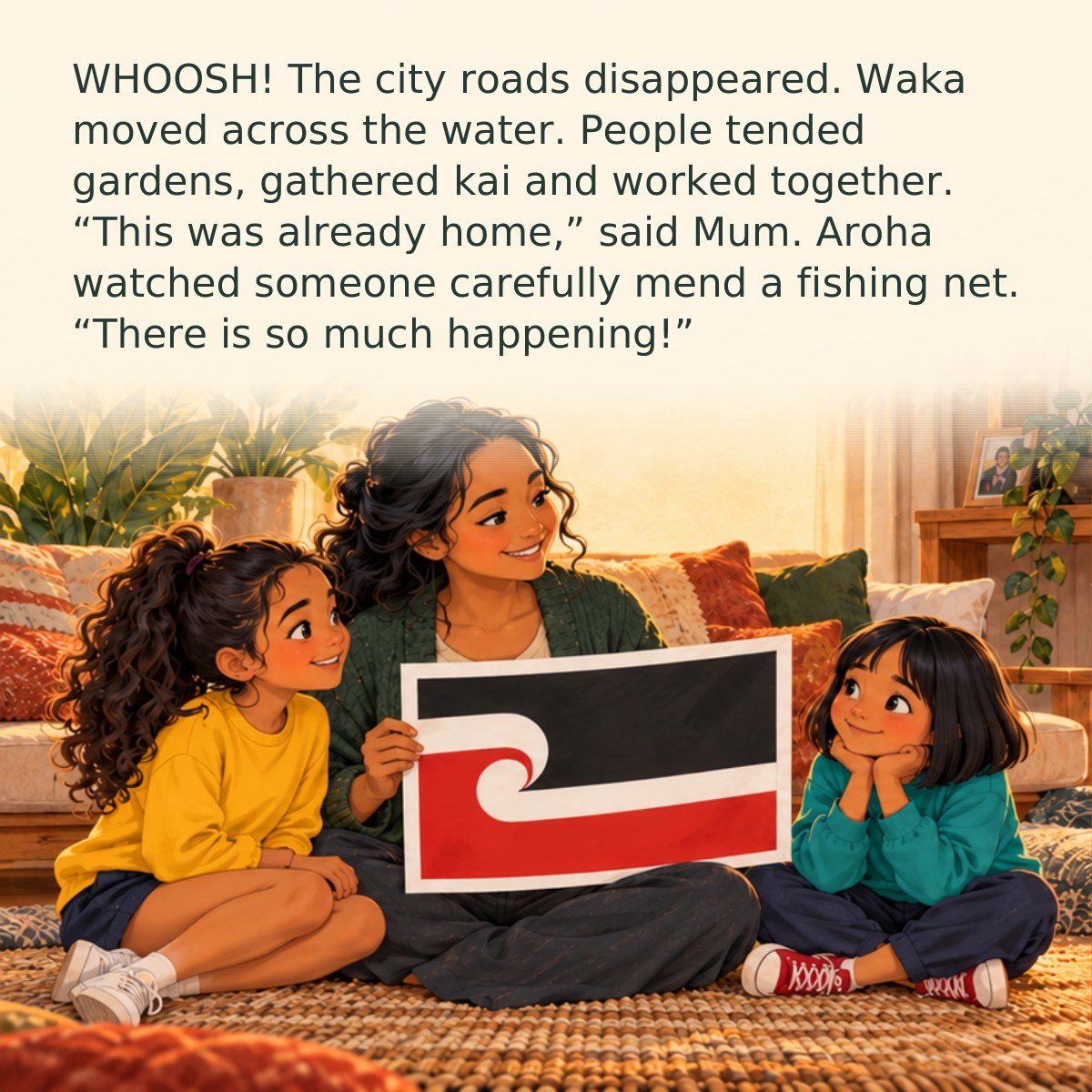
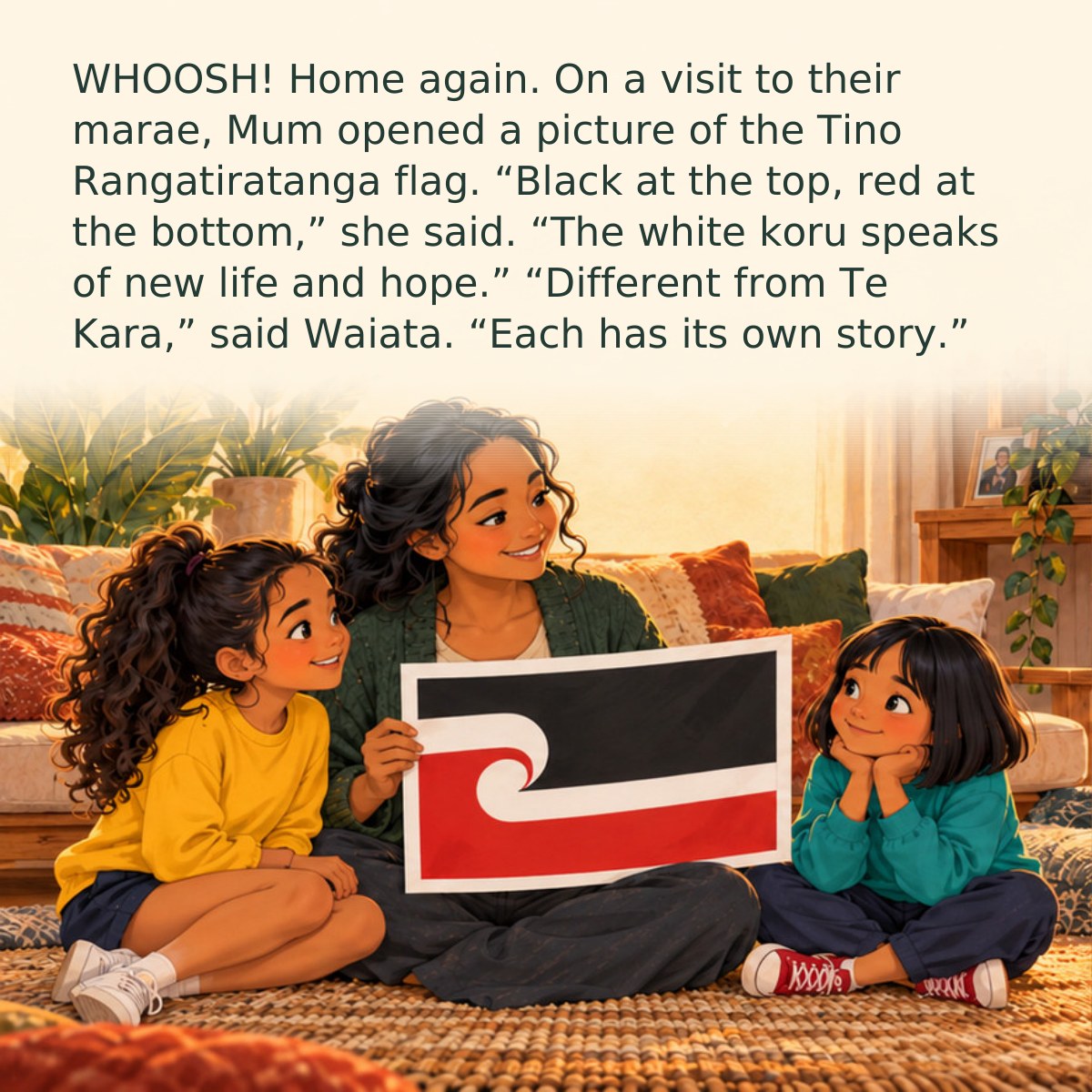
WHOOSH! Home again. On a visit to their marae, Mum opened a picture of the Tino Rangatiratanga flag. “Black at the top, red at the bottom,” she said. “The white koru speaks of new life and hope.” “Different from Te Kara,” said Waiata. “Each has its own story.”
Accessible text
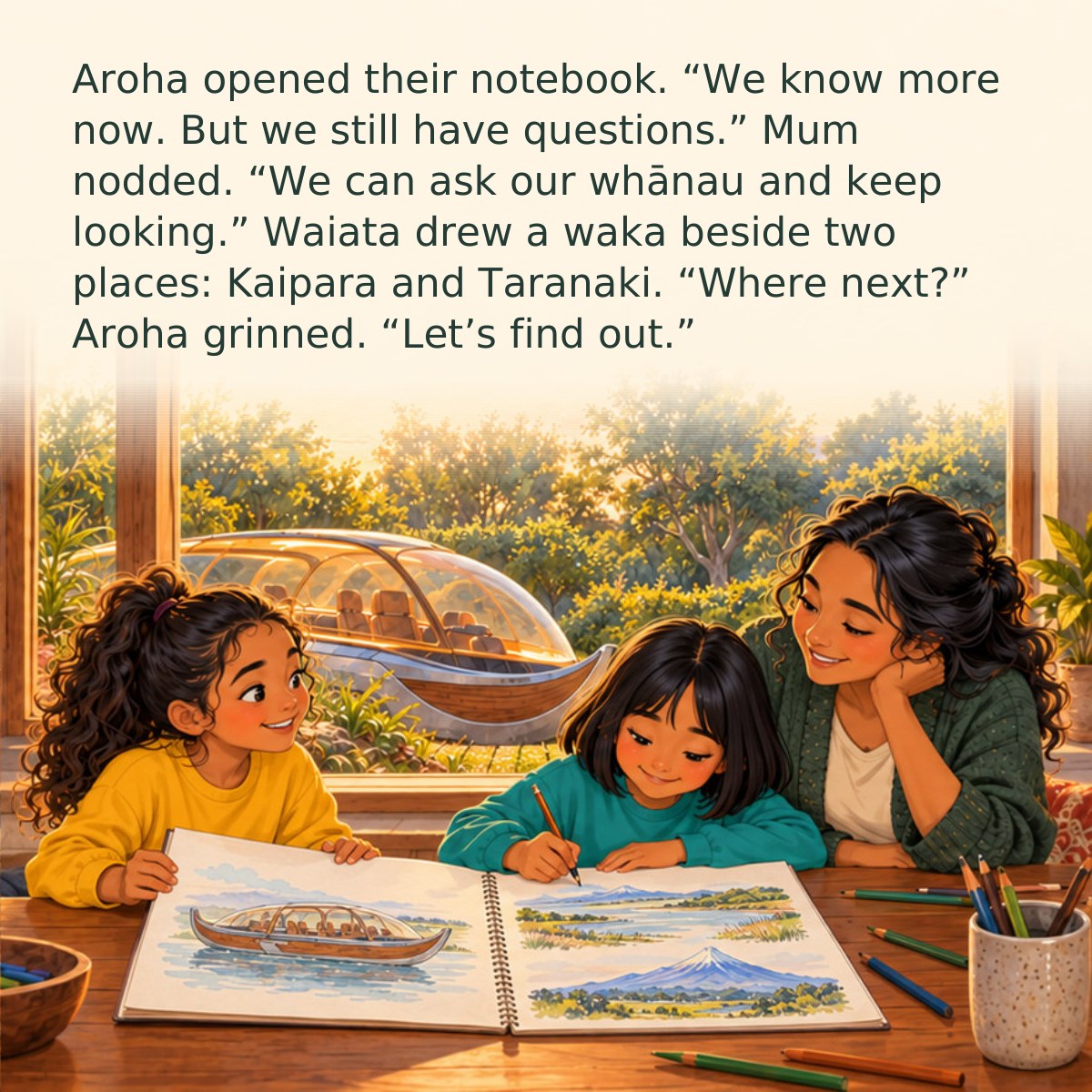
Aroha opened their notebook. “We know more now. But we still have questions.” Mum nodded. “We can ask our whānau and keep looking.” Waiata drew a waka beside two places: Kaipara and Taranaki. “Where next?” Aroha grinned. “Let’s find out.”
Accessible text
Documents and authority Te Kara and He Whakaputanga In 1834, northern rangatira chose Te Kara, the United Tribes flag, at Waitangi. A recognised flag helped New Zealand-built trading ships. In 1835, the signatories to He Whakaputanga declared their sovereignty and independence. These northern events are not presented here as decisions made by every iwi. [2, 3] Te Tiriti and the English text The Māori and English texts differ. The English first article refers to ceding sovereignty; the Māori first article uses kāwanatanga. The Māori second article guarantees tino rangatiratanga. These terms carry meanings that cannot be fully covered by a short children’s gloss. Most rangatira signed the Māori text. [4, 5] What the Tribunal found in 2014 Te Paparahi o Te Raki Stage 1 focused on the February 1840 signings at Waitangi, Waimate and Mangungu. The Tribunal found that those rangatira did not cede sovereignty. They agreed to the Governor controlling British subjects while retaining authority over their own people and territories. That report did not determine how or when the Crown acquired the sovereignty it exercises today. Its finding should not be attributed automatically to every signatory elsewhere. [5] An invitation at Tāmaki Makaurau The Auckland scene concerns Ngāti Whātua Ōrākei. Tuku whenua expressed a relationship with expectations and obligations; it should not be reduced to an unconditional gift with no continuing connection. The author’s Rēweti Marae connection and Ngāti Whātua Ōrākei history are distinct. The children’s marae is fictional. [6]
Accessible text
Land language and resistance The wars and raupatu The New Zealand Wars involved different iwi, regions and circumstances. At Waitara in 1860, British troops attacked Te Kohia on Te Āti Awa whenua after the Crown pursued a disputed purchase. Taranaki iwi is one iwi within the wider Taranaki region. Confiscation, purchases, land laws and other Crown actions contributed to land loss through different processes. The story offers an introduction, not a complete account. [7, 8] Parihaka Parihaka drew people from different communities. Under Te Whiti o Rongomai and Tohu Kākahi, its people resisted land loss without armed fighting. Ploughing protests and imprisonment preceded the Crown invasion of 5 November 1881. The children’s scene names arrests, destruction and displacement; the full history includes further serious harm. Whānau can pause whenever they need to. [8, 9] Te reo Māori School suppression and punishment for speaking Māori are documented. Experiences differed by school, period and whānau. Some parents used English to protect children from punishment or disadvantage. Language survival and revitalisation depended on Māori effort across generations. The unnamed school scene is not a claim about the author’s kuia. [10] Takaparawhā and the Tribunal The 506-day occupation of Takaparawhā/Bastion Point in 1977–1978 concerned Ngāti Whātua Ōrākei land. Its story is separate from the northern inquiry discussed earlier. The Tribunal investigates claims, hears evidence and reports findings and recommendations. It is not a court that has automatically settled every historical question. [5, 11]
Accessible text
Glossary and flag meanings Whakapapa: Connections of descent and relationships between generations. Whenua: Land; a place of belonging and relationship. Mounga: Mountain, in the Taranaki dialect. Most other iwi use maunga. [14] Tūpuna: Ancestors. Hapū: A kinship group with its own relationships and authority. Rangatira: A leader. Taonga: Treasured things, which can include language and knowledge. Raupatu: Confiscation or taking by force; here, Crown land confiscation. Sovereignty: Supreme authority to govern. Tino Rangatiratanga flag Black belongs at the top, red at the bottom, with the upper koru nearest the flagpole. The published design explanation connects black with Te Korekore, red with Te Whai Ao, and white with Te Ao Mārama. The koru expresses renewal, new life and hope. The flag was unveiled in 1990. [12] Te Kara Te Kara has its own history and design variants. The canton belongs at the upper pole side. Its meaning and history are distinct from those of the later Tino Rangatiratanga flag. [2] Kōrero together What surprised us? Which place could we learn about next? Who could help us understand its story?
Accessible text
Sources for further reading [1] Ngā Maunga Whakahii o Kaipara Our History Read this source online [2] Manatū Taonga and Waitangi Treaty Grounds United Tribes flag and Te Kara Read this source online [3] Archives New Zealand The Declaration of Independence of New Zealand Read this source online [4] Waitangi Tribunal Māori and English texts Read this source online [5] Waitangi Tribunal Te Paparahi o Te Raki Stage 1 report release Read this source online [6] Ngāti Whātua Ōrākei and Te Tai Chiefly authority Read this source online [7] Te Kotahitanga o Te Atiawa Waitara and the Wars Read this source online
Accessible text
Sources for further reading [8] Te Kāhui o Taranaki Iwi Taranaki Iwi Deed of Settlement Read this source online [9] Parihaka History Read this source online [10] Manatū Taonga History of the Māori language Read this source online [11] Rāwiri Taonui, Te Ara Ngāti Whātua and the Treaty of Waitangi Read this source online [12] Manatū Taonga Tino Rangatiratanga flag Read this source online [13] Ako Panuku Virtual Background Whakataukī 6 Resource Read this source online [14] Ministry of Education Taranaki Views Read this source online
Accessible text
A WHĀNAU ADVENTURE THROUGH AOTEAROA The Time Waka Our Whānau Journey Through Aotearoa Join Aroha, Waiata and their mum aboard a time-travelling waka as they explore Aotearoa’s past. From thriving Māori communities to Te Tiriti, Parihaka and the survival of te reo Māori, each stop brings new questions about whenua, whānau and belonging. An illustrated adventure that invites tamariki and whānau to learn together, listen carefully and keep discovering their own connections. Niva Gram ICONIC GAMES · iconicgames.co.nz