TERM 4 · WEEK 5
Level Up: Game Master

Create the world. Build the quest. Write the rules. Set the numbers. Test the chance. Balance it. Then play the game you made.
ENGLISH
Create Your Game World
01 · World ForgeLet’s investigate the words for Level Up: Game Master. Look for what changes, then explain what you notice.
WHAT AM I LEARNING?
Identify nouns, adjectives and precise verbs, then use precise vocabulary to describe a game setting clearly.
Learn how nouns, adjectives and verbs do different jobs. Complete four guided language checks, choose a setting, player, collectible, adjective and verb, then independently write one clear world-description sentence using at least one of your precise word choices.
Need help? See the steps
Start with the steps below. They show you what to look for and what to do.
- STEP 1Read or tap each word.
- STEP 2Look closely at the word part the mission is teaching.
- STEP 3Sort, build or compare the words.
- STEP 4Explain the pattern in your own words.

Create Your Game World
Precise words turn an idea into a world another player can picture.
Nouns name what is there. Adjectives add useful detail. Verbs tell the player exactly what happens.
WE DO ONE: “Go to a place” → “Dash through the moonlit ruins.”
Choose your setting, player and collectible to bring the world online.
ENGLISH · MATHS
Build the Quest
02 · Quest DeckRead the Level Up: Game Master information first. Talk the idea through, then answer one small question at a time.
WHAT AM I LEARNING?
Retrieve explicit information, follow a sequence, identify evidence and make a supported inference from a short game-designer brief.
Use the Goal–Sequence–Evidence reading strategy. Read the Quest Engine Brief, retrieve the collection requirement, identify what happens last, select evidence about chance, infer why designers test the chance tool, then choose a quest framing that preserves the playable structure.
Need help? See the steps
Evidence is a clue from the text, picture or data that supports your thinking. An inference is an idea you work out from clues.
- STEP 1Read once to understand what it is mostly about.
- STEP 2Read the question again and find the part that helps.
- STEP 3Say your answer aloud using because, then check it against the text.
- STEP 4Record a useful clue from the source.
- STEP 5Explain what that clue tells you.
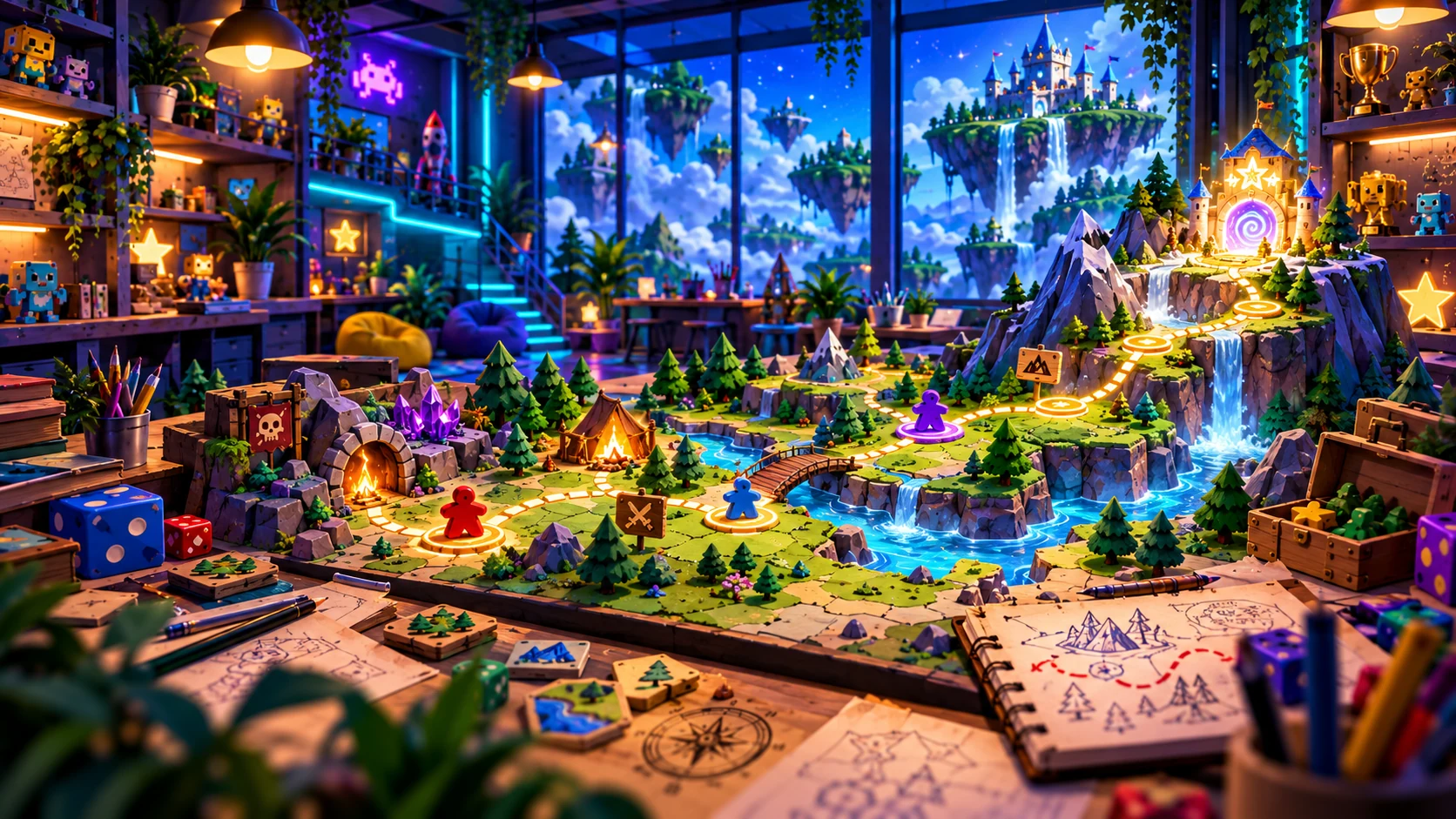
Build the Quest
Read like a game designer: find the goal, the sequence and the details that matter.
Goal tells you what the player is trying to achieve. Sequence tells you what happens first, next and last. Evidence is the exact detail that proves your answer. An inference is an idea you work out by connecting clues.
WE DO ONE: “Collect the key before opening the gate.” Goal clue: open the gate. Sequence clue: collect the key first.
QUEST ENGINE BRIEF — Every game starts at Base Camp. First, the player travels along one adventure path. Before the final portal can be used, the player must collect 3 special objects. Some spaces help the player. Hazards can slow progress or cost points. A chance tool decides what happens on event spaces. Designers test the chance tool because too many difficult outcomes could make the game frustrating or unfair. The game needs a clear goal, rules another player can follow and a fair way to win.
Every option keeps the game playable: collect 3 things → travel the path → reach the goal. You choose what that adventure means.
Choose a quest to add it to your game blueprint.
ENGLISH · TECHNOLOGY
Design the Rules
03 · Rule BuilderYOUR WRITING JOB: Learn and repair a clear if/then rule. Use the guided rule plan to choose the goal, hazard response and boost behaviour. Then write 5 rules independently, one per line, including what happens on a turn, collectibles, one complete if/then condition and a testable win condition.
WHAT AM I LEARNING?
Write an independent five-rule procedure using logical sequence, precise actions, conditional language and an explicit win condition.
Learn and repair a clear if/then rule. Use the guided rule plan to choose the goal, hazard response and boost behaviour. Then write 5 rules independently, one per line, including what happens on a turn, collectibles, one complete if/then condition and a testable win condition.
Need help? See the steps
Start with the steps below. They show you what to look for and what to do. First get your ideas ready. Then build the writing one part at a time.
- STEP 1Introduce what you are writing about.
- STEP 2Give your first important idea.
- STEP 3Add another useful detail, reason or example.
- STEP 4Finish so the reader understands your message.

Design the Rules
A good rule is ordered, specific and testable. Another player should not have to guess.
WE DO ONE: “You lose points sometimes.” → “If you land on a hazard, then lose 10 points.”
Which version is easiest for another player to test?
1Collect 3 special objects and reach the goal.
2On each turn, use the chance tool and follow the movement result.
3Collect each special object when you pass its checkpoint.
4If you hit a hazard, then lose 75 points.
5If you find a boost, then use its power.
Use the plan above, then write 5 clear rules in your own words. Put each rule on a new line. Include what happens on a turn, how collectibles work, one complete if/then rule, and exactly how the player wins.
MATHS
Build the Game Numbers
04 · Number CoreWork through one maths question at a time. Your answers will be checked before the next mission unlocks.
WHAT AM I LEARNING?
Use Year 4 multiplication, two-digit-by-one-digit multiplication, addition and subtraction to calculate values that become the game's score system.
Use the worked strategy models, then solve: 1) 7 × 8 common collectible points. 2) 23 × 4 rare-event points. 3) 275 + 125 portal bonus. 4) 350 − 75 points remaining after a hazard.
Need help? See the steps
Start with the steps below. They show you what to look for and what to do.
- STEP 1Read the question and decide what you need to find.
- STEP 2Notice the important numbers and units.
- STEP 3Choose a strategy and work it out.
- STEP 4Type the answer, then check that it makes sense.

Build the Game Numbers
Solve the score calculations. Every correct answer becomes a real value in your final game.
Altogether can signal addition. Times as many can signal multiplication. Remain can signal subtraction.
WE DO ONE: 2 groups of 4 → 2 × 4 = 8.
MATHS · TECHNOLOGY
Probability Power-Up
05 · Chance LabThis is your real-world Level Up: Game Master challenge. Work out what the problem asks you to find or make.
WHAT AM I LEARNING?
Describe and compare chance events, make a prediction and compare it with data from genuinely repeated random trials.
Use an 8-outcome chance tool: 4 MOVE, 2 COLLECT, 1 BOOST and 1 HAZARD. Complete the likelihood checks, predict which outcome will occur most often, run 10 independent random trials, compare the observed counts with the prediction, then choose the visual chance-tool style for the final game.
Need help? See the steps
Start with the steps below. They show you what to look for and what to do.
- STEP 1Read the whole challenge once.
- STEP 2Find the numbers, facts or rules you need.
- STEP 3Choose a useful strategy.
- STEP 4Show your solution clearly enough that someone else could follow it.

Probability Power-Up
Chance makes games exciting, but designers need to understand what is likely to happen.
This prototype has 8 equal outcomes. More sections means an outcome is more likely, but a short test can still vary.
OUTCOMES
Which outcome do you think will appear most often across 10 trials? A prediction is what you expect before collecting the data.
Each trial is drawn independently from the same 8-outcome chance tool. Your results can change each time you test.
MATHS
Playtest & Balance
06 · Playtest ZoneRun repeated turns on your prototype, watch the event counts, then use evidence to make one balance decision. Your final game will use the choice you make here.

Playtest & Balance
Real designers test, collect evidence and change one thing at a time.
Predict → Test → Record → Compare → Improve. A game does not become fairer just because we say it is. Use what happened in the test.
WE DO ONE: “I predict MOVE will happen most because it has 4 of the 8 chance sections.” After testing, compare that prediction with the event counts.
Choose one claim to test during your 8-turn prototype.
Choose one design decision after your playtest. Any of these can work because the final game keeps hazards safe and recoverable.
Build My Game
07 · Build ChamberThis part is about your own learning. There are no right or wrong feelings.
WHAT AM I LEARNING?
Combine completed English, maths, probability and playtest evidence into one playable game, then reflect on the learning used to build it.
Complete Missions 1–6, including the independent rulebook and evidence-based playtest decision. Name and build your finished quest game, then play it to collect all 3 objects and reach the portal. Finish with the standard Week 5 Check In.
Need help? See the steps
Choose what feels true for you, then write one thing you understand better now.
- STEP 1Choose how the week felt.
- STEP 2Write one thing you understand better now.

Build My Game
Your English and maths have been creating this all week. Now assemble the pieces and play it.
MY GAME
Designed by you · powered by English + maths


Your game works because every mission contributed one part of the design.
How did this week feel?
There are no right or wrong answers. Choose what feels true for you.