Something we can verify with a reliable source, record, measurement or direct observation.
“The test lasted 30 minutes.”TERM 3 · WEEK 2
Newsroom

Find the story. Check the evidence. Interview a source. Publish the news.
0 / 7 missions complete
ENGLISH
News Detective: Fact, Viewpoint or Needs Evidence?
01 · News DeskLet’s investigate the words for Newsroom. Look for what changes, then explain what you notice.
WHAT AM I LEARNING?
I can choose precise words and explain how shades of meaning change a message.
YOUR MISSION
Which phrase signals uncertainty rather than certainty?
TEACH · LEARN THE IDEA
Writers choose words for precision. Near-synonyms are not always interchangeable: each can suggest a different strength, attitude or level of certainty.
- STEP 1Read or tap each word.
- STEP 2Look closely at the word part the mission is teaching.
- STEP 3Sort, build or compare the words.
- STEP 4Explain the pattern in your own words.
NEWS DESK · LANGUAGE CHECK
0 / 8Fact, viewpoint, or needs more evidence?
What somebody thinks, feels, prefers or believes.
“I think the robot is brilliant.”A claim that goes further than the information we have.
“The robot will save every native bird.”REPORTER TIP
Words such as probably or according to are clues, not automatic answers. Read the whole sentence and ask: Can this actually be checked?
YEAR 5 DEEP DIVE · REQUIRED Complete this deeper Year 5 mahi as part of the mission — not as an optional extra.
Do the main mission first, then complete this section. It is deliberately more independent than Year 4 and is part of your weekly homework workload.
CHECK THE CORE IDEA
Which phrase signals uncertainty rather than certainty?
ENGLISH
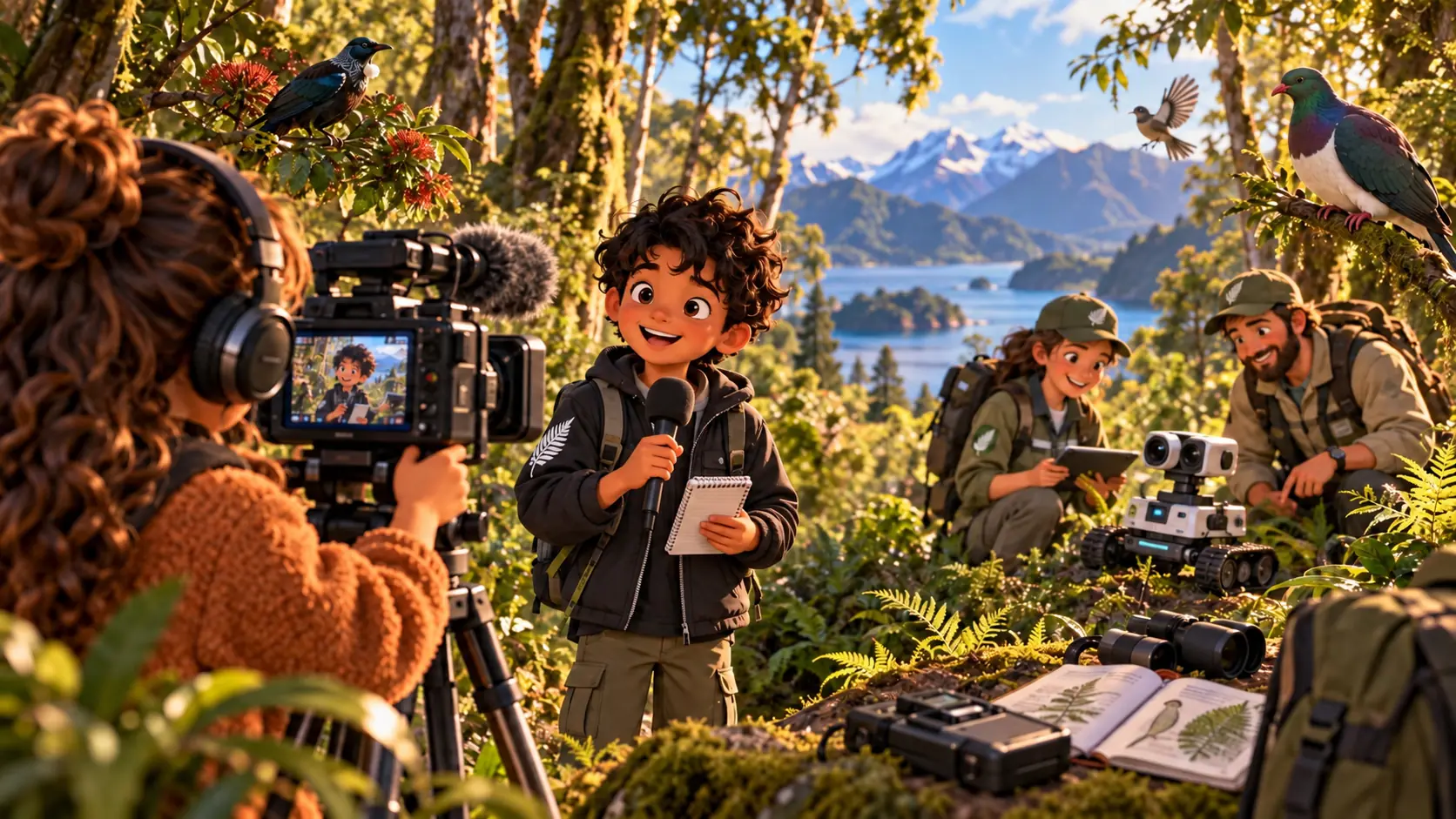
Breaking News: Robot Rangers
02 · Broadcast DeskRead the Newsroom information first. Talk the idea through, then answer one small question at a time.
WHAT AM I LEARNING?
I can distinguish fact, opinion and claims that need evidence.
YOUR MISSION
Best newsroom conclusion?
TEACH · LEARN THE IDEA
A reliable claim can be checked against evidence. Look for named sources, data, direct observations and whether the writer separates fact from viewpoint.
- STEP 1Read once to understand what it is mostly about.
- STEP 2Read the question again and find the part that helps.
- STEP 3Say your answer aloud using because, then check it against the text.
- STEP 4Record a useful clue from the source.
- STEP 5Explain what that clue tells you.
BREAKING NEWS TRAINING
5W + evidenceWatch a real report, then take reporter notes
REAL NEWS EXAMPLE · KEA KIDS NEWS
Watch how a young reporter builds a story
Reporter Inaya investigates a question about children and AI. While you watch, notice how the report mixes a checkable number, reporter narration and interviews with different viewpoints.
WHO? Who is interviewed?FACT? What can be checked?VIEWPOINT? What does somebody think?SOURCE? Where did information come from?
Video blocked at school? No problem. The fictional training bulletin below contains everything you need to complete the mission.
NOW YOU TRY · TRAINING BULLETIN
Use the same reporter skills on our fictional conservation story.
MĪHARO NEWS · TRAINING BULLETINFICTIONAL REPORT

ROBOT RANGERS HELP COUNT NATIVE BIRDSA conservation team tests a camera robot in an Aotearoa forest reserve.
Listen first if you can. The transcript is available so everyone can complete the mission.
READ THE TRAINING REPORT
FICTIONAL TRAINING REPORT. ROBOT RANGERS HELP COUNT NATIVE BIRDS. On Tuesday, a conservation team tested a small camera robot in a fenced forest reserve in Aotearoa. The test lasted 30 minutes. The camera recorded 18 bird sightings across four species: 8 tūī, 5 pīwakawaka, 3 kererū and 2 korimako. Ranger Hana Lee said, “The robot helped us look under thick plants without disturbing nests.” The team said the robot is a useful tool, but one short test cannot tell rangers how many birds live in the whole forest. More counts would be needed before making a bigger conclusion.
REPORTER NOTEBOOKFind the information a reporter would record.
1 · WHO is this story mainly about?
2 · WHERE did the test happen?
3 · Which is a FACT from the report?
4 · Which sentence is a QUOTE from a source?
5 · What is the main PURPOSE of this report?
6 · What can the report NOT prove?
YEAR 5 DEEP DIVE · REQUIRED Complete this deeper Year 5 mahi as part of the mission — not as an optional extra.
Do the main mission first, then complete this section. It is deliberately more independent than Year 4 and is part of your weekly homework workload.
A community post says a new cycleway has ‘made traffic much worse’. Council count data shows average vehicle numbers on the road fell slightly after the cycleway opened, while one nearby street recorded a small increase. The post gives no source for its claim.
Fluency check: read the source aloud once at a natural pace, pausing where the punctuation tells you to.CHECK THE CORE IDEA
Best newsroom conclusion?

ENGLISH
Investigate & Interview
03 · Field DeskThis is your real-world Newsroom challenge. Work out what the problem asks you to find or make.
WHAT AM I LEARNING?
I can use evidence to recommend an action.
YOUR MISSION
Write three interview questions that would help verify the claim. Explain which source or person each question should target.
TEACH · LEARN THE IDEA
A recommendation should link evidence to a decision. State the evidence, explain what it means, then justify the action you propose.
- STEP 1Read the whole challenge once.
- STEP 2Find the numbers, facts or rules you need.
- STEP 3Choose a useful strategy.
- STEP 4Show your solution clearly enough that someone else could follow it.
FIELD REPORTING
research + interviewInvestigate a real story from your world
REPORTER SAFETY
Choose a safe everyday story. Do not enter a home address, phone number, email address, school login, or other private information. First names or roles such as “Dad”, “my coach” or “my friend” are enough.
INTERVIEW SCHOOLTOO CLOSED“Did you like it?” BETTER REPORTER QUESTION“What was the most exciting part, and why?”
Ask questions that lead to useful answers
This might only get yes or no.
This gives your source something interesting to explain.
YEAR 5 DEEP DIVE · REQUIRED Complete this deeper Year 5 mahi as part of the mission — not as an optional extra.
Do the main mission first, then complete this section. It is deliberately more independent than Year 4 and is part of your weekly homework workload.
YOU TRY
Write three interview questions that would help verify the claim. Explain which source or person each question should target.
Minimum guide: 80 words. Quality matters: make the reasoning, evidence or design decision clear. □ answers the exact task□ uses specific detail□ ideas are connected□ reread and improved

MATHS
Data Desk: Check the Headline
04 · Data DeskWork through one maths question at a time. Your answers will be checked before the next mission unlocks.
WHAT AM I LEARNING?
I can interpret and compare data, describe patterns and justify conclusions.
YOUR MISSION
1) Traffic count 1,240 falls by 85 2) Increase from 320 to 368
TEACH · LEARN THE IDEA
Read scales carefully, compare categories or time points and distinguish the data from your explanation of why a pattern might exist.
- STEP 1Read the question and decide what you need to find.
- STEP 2Notice the important numbers and units.
- STEP 3Choose a strategy and work it out.
- STEP 4Type the answer, then check that it makes sense.
NEWSROOM DATA DESK
statisticsRead the data before you write the headline
Frequency means how many times something appears. A bar graph makes frequencies easy to compare.
A headline must agree with the numbers. If the data does not support the claim, the headline needs to change.
86420
Bird sightings during the 30-minute robot test Frequency = number of sightings FACT-CHECK THIS HEADLINE Total sightings Half of 18 There were 8 tūī. Is 8 more than 9?
“More than half the bird sightings were tūī.”
CHECK THE NUMBERS
YEAR 5 DEEP DIVE · REQUIRED Complete this deeper Year 5 mahi as part of the mission — not as an optional extra.
Do the main mission first, then complete this section. It is deliberately more independent than Year 4 and is part of your weekly homework workload.
CORE YEAR 5 QUESTIONS

ENGLISH
Reporter School: Write & Publish
05 · Publishing DeskYOUR WRITING JOB: Write a short news report that distinguishes verified information from a viewpoint or claim that still needs evidence.
WHAT AM I LEARNING?
I can write an informative report that groups related ideas and uses evidence.
YOUR MISSION
Write a short news report that distinguishes verified information from a viewpoint or claim that still needs evidence.
TEACH · LEARN THE IDEA
Reports use a clear focus, grouped information and accurate vocabulary. Select evidence that supports the purpose and avoid irrelevant detail.
- STEP 1Introduce what you are writing about.
- STEP 2Give your first important idea.
- STEP 3Add another useful detail, reason or example.
- STEP 4Finish so the reader understands your message.
REPORTER SCHOOL + PUBLISHING DESK
edit → write → publishLearn the writing tools, then publish your own story
QUICK REVISION
News writing still needs the punctuation you already know.
Do each edit before the publishing desk opens. Read the teaching note first, then choose the version that is ready for publication.
CAPITAL LETTERSNames, days and the beginning of a sentence need capital letters.
Which version is ready for a news report?
QUESTION MARKSAn interview question asks something and ends with a question mark.
Which question is punctuated correctly?
SPEECH MARKSSpeech marks wrap the exact words somebody said.
Which sentence shows the speaker's exact words correctly?
PARAGRAPHSStart a new paragraph when the report moves to another part of the story.
Which plan is easier for a reader to follow?
BUILD A QUOTE
Turn an interview answer into direct speech
- 1Find the exact words the person said.
- 2Put an opening speech mark before the first spoken word.
- 3Start the spoken sentence with a capital letter.
- 4Put the spoken punctuation before the closing speech mark.
- 5Tell the reader who said it.
MODEL“I was nervous at first, but then I had fun,” Mia said.
Short, interesting and accurate.
Tell the most important who, what, when and where.
Add checkable facts, numbers and useful context.
Add a source's exact words with speech marks.
✓ capitals✓ sentence punctuation✓ 2 paragraphs✓ checkable facts✓ attributed quote✓ accurate headline
YEAR 5 DEEP DIVE · REQUIRED Complete this deeper Year 5 mahi as part of the mission — not as an optional extra.
Do the main mission first, then complete this section. It is deliberately more independent than Year 4 and is part of your weekly homework workload.
YOU TRY
Write a short news report that distinguishes verified information from a viewpoint or claim that still needs evidence.
Minimum guide: 110 words. Quality matters: make the reasoning, evidence or design decision clear. □ answers the exact task□ uses specific detail□ ideas are connected□ reread and improved

ENGLISH
Newsroom Scatter
06 · Newsroom ArcadeGAME BREAK
Complete three Scatter rounds. Use the round letter to build WHO + ACTION + WHAT + WHERE. Your ACTION must be a strong headline verb, and you must read the finished headline aloud and check that it makes sense before banking it.
GAME BREAK · NEWSROOM SCATTER
ROUND 1 / 3 · SCORE 0 / 12 Beat the letter. Build a headline that makes sense.
HEADLINE SCHOOL
A headline needs more than random words.
Use this order so your reader can understand the news:
WHOthe subject + ACTIONstrong headline verb + WHATwhat the action affects + WHEREthe place
GOOD MODEL Bob Builds Boat in Brisbane
Bob tells us who. Builds tells us what Bob does. Boat tells us what he builds. Brisbane tells us where.
NOT READY Bob · Boat · Building · Brisbane
These are B words, but they do not yet tell the news as a clear sentence.
HOW TO PLAY
Each round gives you one letter. Your four important words must begin with that letter. Small glue words such as in or at do not have to. The timer starts as soon as you begin typing.
THIS ROUND'S LETTERBAll four important words start with this letter.
60seconds Starts when you type
STRONG HEADLINE VERB
For ACTION, use a verb that works straight after WHO. News headlines often use strong present-tense verbs: Builds · Breaks · Brings · Buys.
Avoid -ing here. “Bob biking…” is unfinished. “Bob bikes…” tells us what Bob does.
REPORTER CLUE
NEWSROOM DRAFT
READ IT ALOUD.
Can you clearly hear who did what, to what, and where?
YOUR NEWS TICKER
YEAR 5 DEEP DIVE · REQUIRED Finish the game, then prove the learning in the final rounds.
Do the main mission first, then complete this section. It is deliberately more independent than Year 4 and is part of your weekly homework workload.
YEAR 5 GAME CHECK
Finish the game first, then use the learning from this week to clear these three final rounds.
Newsroom Debrief
07 · Editor DeskThis part is about your own learning. There are no right or wrong feelings.
WHAT AM I LEARNING?
Reflect on independence, challenge level and the next useful Year 5 practice step.
YOUR MISSION
What made a source or claim trustworthy enough to publish?
TEACH · LEARN THE IDEA
Choose what feels true for you, then write one thing you understand better now.
- STEP 1Choose how the week felt.
- STEP 2Write one thing you understand better now.
How did this week feel?
There are no right or wrong answers. Choose what feels true for you.