CCTV FOOTAGEWatch the hallway camera
Watch for observable details. The footage can show where someone was, but it cannot automatically prove what they did.
TERM 3 · WEEK 4

Investigate the clues. Test the evidence. Build your case.
ENGLISH
Let’s investigate the words for Case Files: Build Your Case. Look for what changes, then explain what you notice.
I can choose precise words and explain how shades of meaning change a message.
Which phrase clearly marks an inference rather than a fact?
Writers choose words for precision. Near-synonyms are not always interchangeable: each can suggest a different strength, attitude or level of certainty.
These two sources help you learn the investigation words in context. Watch what the camera actually shows, then listen carefully to the witness account.
Watch for observable details. The footage can show where someone was, but it cannot automatically prove what they did.
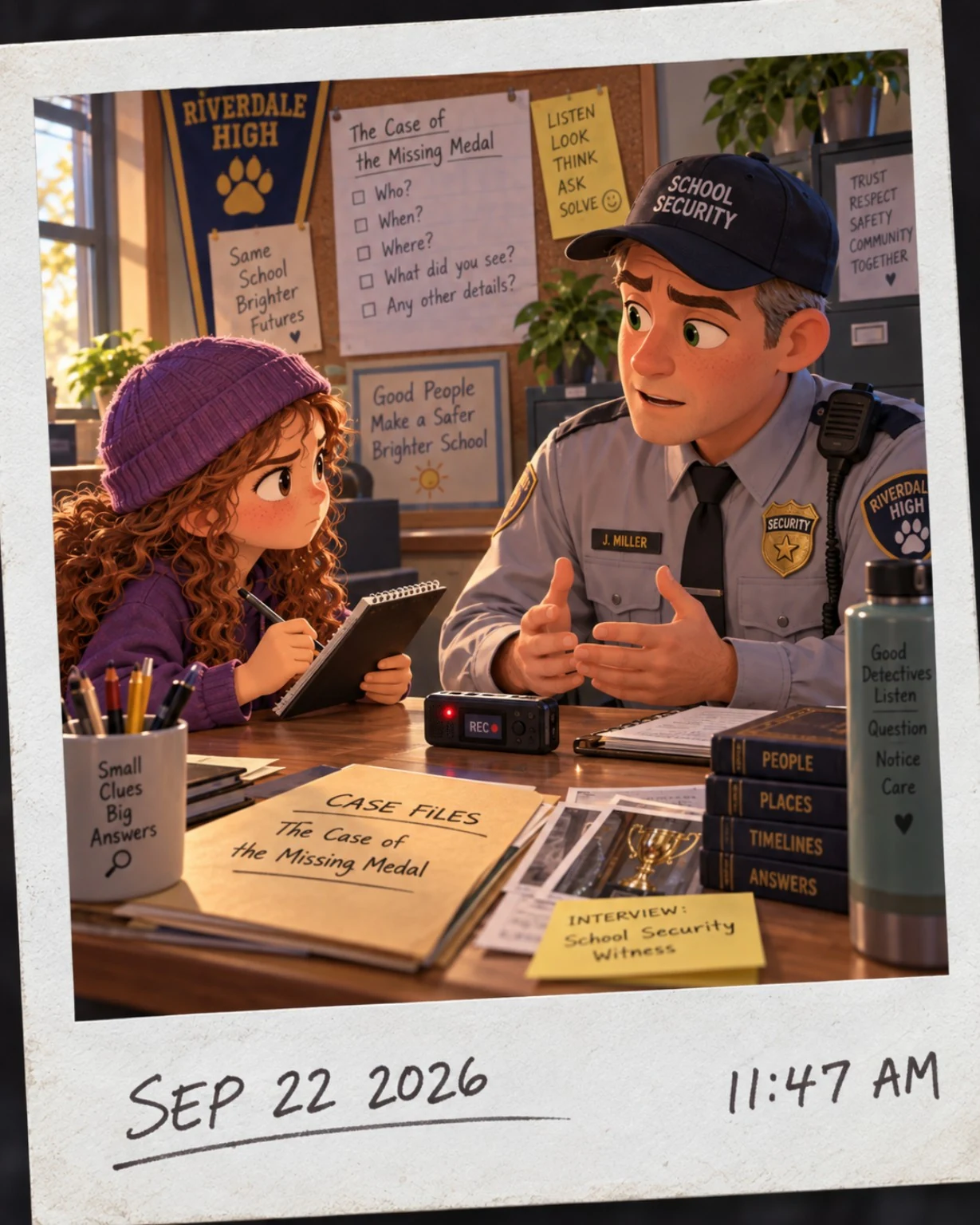
INVESTIGATOR (Katie): I’m going to ask you a few questions as part of our investigation. Can you tell me what you saw?
SECURITY GUARD: Yeah. I was doing my usual evening check when I noticed something unusual. Someone came out through the side doors at around eight o’clock.
INVESTIGATOR (Katie): What did they look like?
SECURITY GUARD: They were wearing a hoodie, blue jeans and dark shoes. I thought it might have been a man, but I’m uncertain because I couldn’t see their face clearly.
INVESTIGATOR (Katie): What did you observe after they left the building?
SECURITY GUARD: I watched their movement across the car park. They walked toward the gate and didn’t stop or speak to anyone.
INVESTIGATOR (Katie): Were they carrying anything?
SECURITY GUARD: Not that I could see. I was watching carefully, but they were only in view for a few seconds.
INVESTIGATOR (Katie): Did you recognise them?
SECURITY GUARD: No. I didn’t recognise them at all.
INVESTIGATOR (Katie): Okay. I’ll record your observation and compare it with the other evidence. Thanks for helping with the investigation.
Listen to the recording, then notice how the speakers use these exact words. Some words change form when their job in the sentence changes.
Katie asks what the guard observed. At the end she says she will record his observation. The verb tells us the action; the noun names what was noticed.
Katie asks, “What did you observe?” and later says, “I’ll record your observation.” Which word pair shows an action changing into the thing that was noticed?
Use the witness statement to choose the meaning or word relationship that fits.The guard says, “I’m uncertain because I couldn’t see their face clearly.” What does uncertain mean here?
Use the witness statement to choose the meaning or word relationship that fits.The guard says, “I was watching carefully.” Which explanation is correct?
Use the witness statement to choose the meaning or word relationship that fits.Katie asks what the guard observed, and he says, “I watched their movement across the car park.” Which pair belongs together?
Use the witness statement to choose the meaning or word relationship that fits.The guard says, “I didn’t recognise them at all.” What does recognise mean?
Use the witness statement to choose the meaning or word relationship that fits.Katie says she will “compare it with the other evidence.” What does compare mean?
Use the witness statement to choose the meaning or word relationship that fits.Katie says she will compare the observation with the other evidence. What is evidence?
Use the witness statement to choose the meaning or word relationship that fits.Katie says the questions are “part of our investigation.” Which explanation is correct?
Use the witness statement to choose the meaning or word relationship that fits.Do the main mission first, then complete this section. It is deliberately more independent than Year 4 and is part of your weekly homework workload.
Which phrase clearly marks an inference rather than a fact?
ENGLISH
Read the Case Files: Build Your Case information first. Talk the idea through, then answer one small question at a time.
I can infer, justify ideas and select the strongest evidence.
Which conclusion is supported?
Inference combines what the text says with what you already know. Strong answers point to specific evidence and explain how it supports the inference.
1. What is the claim? 2. What is the reason? 3. Which details are evidence? 4. What does the evidence not prove yet?
“A hooded figure was near the sports office” is evidence about where that person was. It is not evidence that they stole the medal, because the camera cannot see inside the display area or what they were carrying.
Review the four exhibits, then use the timeline to decide what the evidence supports — and what it does not prove.
Statement A: “The hooded figure must have stolen the medal because they were nearby.”
Statement B: “The evidence shows the medal was removed, but we need more information before we decide why or by whom.”
Which statement is a claim that goes further than the evidence?
Use only what the case file actually tells you.Which detail is checkable evidence from the case file?
Use only what the case file actually tells you.Which conclusion is best supported right now?
Use only what the case file actually tells you.What can the hallway camera NOT prove?
Use only what the case file actually tells you.Do the main mission first, then complete this section. It is deliberately more independent than Year 4 and is part of your weekly homework workload.
The trophy cabinet was locked at 2:50 pm. A photo taken at 3:05 pm shows the medal still inside. At 3:20 pm the medal was reported missing. Three people were in the hall during that time, but the evidence does not show who opened the cabinet.
Fluency check: read the source aloud once at a natural pace, pausing where the punctuation tells you to.Which conclusion is supported?
ENGLISH
YOUR WRITING JOB: Write a claim about what should be investigated next. Use two pieces of evidence, explain your reasoning and address one alternative possibility.
I can build an argument using a claim, evidence, reasoning and a response to another viewpoint.
Write a claim about what should be investigated next. Use two pieces of evidence, explain your reasoning and address one alternative possibility.
An argument is stronger when it explains why the evidence supports the claim and considers a reasonable counter-view.
A persuasive case is easier to follow when each paragraph has a job. You are persuading the investigation team about the next step — you are not accusing anyone.
Say which next step should come first, tell why, and use a detail from the case file.
Add another reason. Use an if…then sentence, then finish with a careful conclusion.
“Investigators should check the sports-office access record first because CCTV shows a hooded figure nearby at 8:12 p.m. If a staff visit is recorded, then investigators will know who to ask for more information.”
Choose one next step: check the sports-office access record, interview the sports coach, or review another camera angle. Write two short paragraphs with two reasons, evidence from the case file, one if…then sentence and a careful conclusion.
Do the main mission first, then complete this section. It is deliberately more independent than Year 4 and is part of your weekly homework workload.
Write a claim about what should be investigated next. Use two pieces of evidence, explain your reasoning and address one alternative possibility.
Minimum guide: 110 words. Quality matters: make the reasoning, evidence or design decision clear.MATHS
Work through one maths question at a time. Your answers will be checked before the next mission unlocks.
I can find unknown values and explain equality in number sentences.
1) □ + 3,480 = 9,000 2) 7 × □ = 196
The equals sign means both sides have the same value. Use inverse operations and known facts to find an unknown.
An equals sign means the same value as. In Equation Court, calculate both sides before you decide whether a statement is true. For a missing number, use the opposite operation to uncover it.
12 + 8 = 4 × 5. Left side: 20. Right side: 20. Both sides match, so the equation is true. For □ + 9 = 15, do 15 − 9, so □ = 6.
Work out both sides before you decide.
Decision waiting.Do both calculations. Are the totals equal?
Decision waiting.Use the opposite operation: 92 − 37.
Decision waiting.Ask: 56 ÷ 7 = ?
Decision waiting.Do the main mission first, then complete this section. It is deliberately more independent than Year 4 and is part of your weekly homework workload.
MATHS
This is your real-world Case Files: Build Your Case challenge. Work out what the problem asks you to find or make.
I can compare options using more than one criterion and justify a decision.
Choose the strongest next investigative step from two possible options. Compare relevance, reliability and what new evidence each could provide.
Real decisions often involve trade-offs. Compare the same criteria for each option, then explain which matters most for the purpose.
Two totals can be hard to compare when they cover different numbers of groups. Find the cost per group: total cost ÷ number of groups.
$24 for 4 groups → 24 ÷ 4 = $6 per group. Now every option can be compared using the same unit.
48 ÷ 6 = ?
54 ÷ 9 = ?
If cost per group is the only factor, which option is better value?
Calculate both costs before you decide.Do the main mission first, then complete this section. It is deliberately more independent than Year 4 and is part of your weekly homework workload.
Choose the strongest next investigative step from two possible options. Compare relevance, reliability and what new evidence each could provide.
Minimum guide: 80 words. Quality matters: make the reasoning, evidence or design decision clear.ENGLISH
Use the three CCTV clues to rule out people who do not match. Identify the person in the footage, then decide what the evidence really proves. Finding a match is not the same as proving a theft.
Use each clue to rule out people who do not match the CCTV evidence. Finding the person in the footage is not the same as proving a theft.
Tap every child to rule them out.
0 of 8 people ruled out for this clue.You have identified the person in the footage. But good investigators do not turn identification into an accusation.
The coach was the person in the CCTV, but the medal was not stolen. New evidence changed the explanation.
Watch the final reveal. The case is complete when the video finishes.
Do the main mission first, then complete this section. It is deliberately more independent than Year 4 and is part of your weekly homework workload.
Finish the game first, then use the learning from this week to clear these three final rounds.
This part is about your own learning. There are no right or wrong feelings.
Reflect on independence, challenge level and the next useful Year 5 practice step.
How did considering another possibility make your argument stronger?
Choose what feels true for you, then write one thing you understand better now.
There are no right or wrong answers. Choose what feels true for you.
Everyone learns differently. Choose anything that helps you. You can change these anytime.
Need something later? Tap your Homework Club buddy. Help is for everyone.