Colour can group ideas and create contrast. Meanings are not universal, so a designer explains what their colours are intended to mean.
TERM 3 · WEEK 6
Flag Lab: Symbols of the World
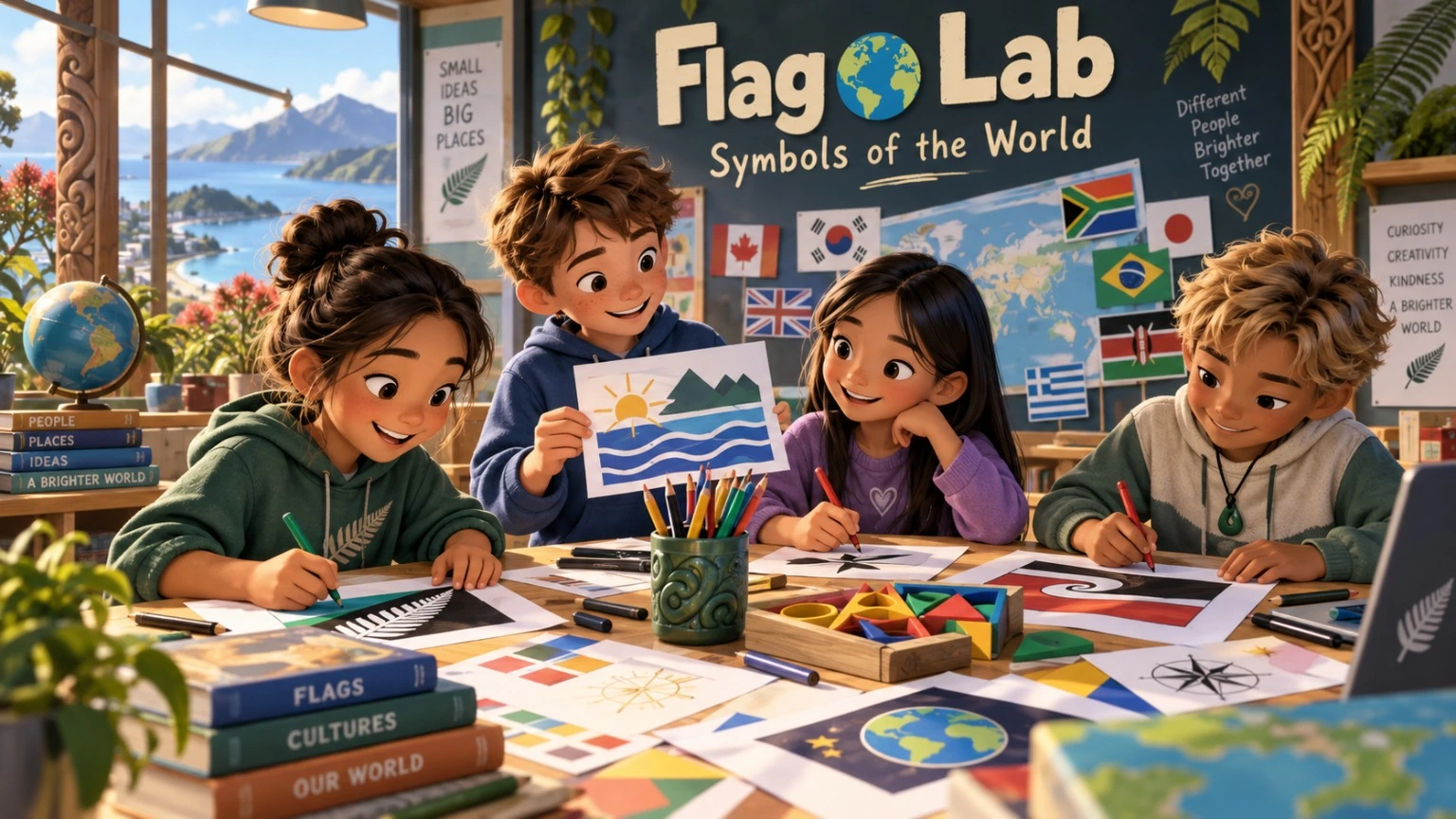
Notice how flags communicate. Check the history. Use geometry. Design, test and explain your own flag.
0 / 7 missions complete
THE ARTS
Visual Language: Colour, Shape & Symbol
01 · Visual Language LabLet’s investigate the words for Flag Lab: Symbols of the World. Look for what changes, then explain what you notice.
WHAT AM I LEARNING?
I can choose precise words and explain how shades of meaning change a message.
YOUR MISSION
Contrast in a design means…
TEACH · LEARN THE IDEA
Writers choose words for precision. Near-synonyms are not always interchangeable: each can suggest a different strength, attitude or level of certainty.
- STEP 1Read or tap each word.
- STEP 2Look closely at the word part the mission is teaching.
- STEP 3Sort, build or compare the words.
- STEP 4Explain the pattern in your own words.
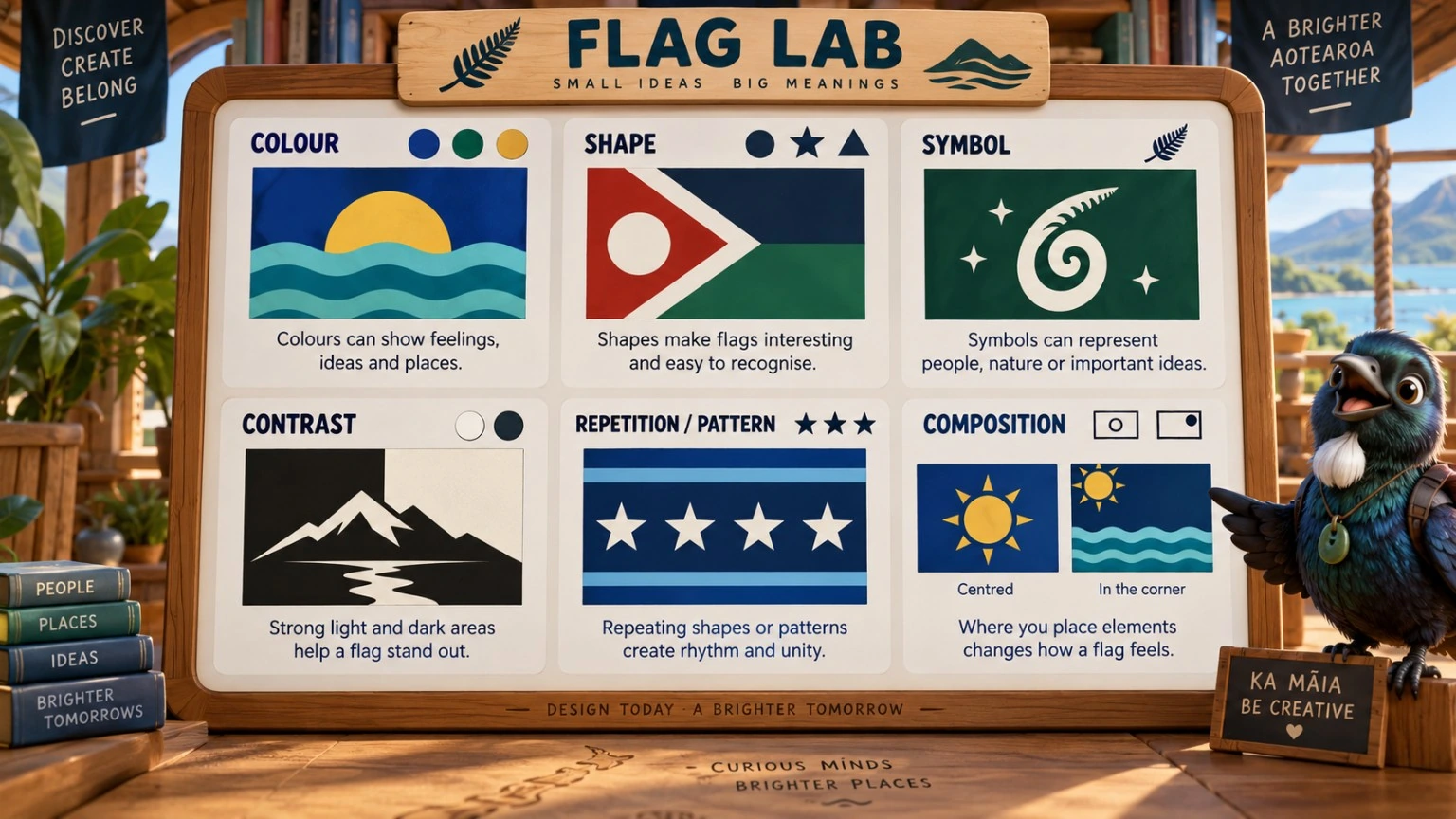
Simple shapes are easy to recognise. Composition is where the parts sit — centred, repeated, in a corner, or arranged in bands.
A symbol stands for an idea. Repeated shapes or colours can create a pattern and make a design feel connected.
PRACTISE · MATCH THE PRINCIPLE
YEAR 5 DEEP DIVE · REQUIRED Complete this deeper Year 5 mahi as part of the mission — not as an optional extra.
Do the main mission first, then complete this section. It is deliberately more independent than Year 4 and is part of your weekly homework workload.
CHECK THE CORE IDEA
Contrast in a design means…
SOCIAL SCIENCES · ENGLISH
Flag Stories: Aotearoa & the World
02 · Flag Stories DeskRead the Flag Lab: Symbols of the World information first. Talk the idea through, then answer one small question at a time.
WHAT AM I LEARNING?
I can identify viewpoint, author purpose and how language positions a reader.
YOUR MISSION
Why should a viewer consider context?
TEACH · LEARN THE IDEA
Authors select details and language for a purpose. Ask whose viewpoint is centred, what the writer wants the reader to think or do, and what may be missing.
- STEP 1Read once to understand what it is mostly about.
- STEP 2Read the question again and find the part that helps.
- STEP 3Say your answer aloud using because, then check it against the text.
- STEP 4Record a useful clue from the source.
- STEP 5Explain what that clue tells you.
Flag of the United Tribes of New Zealand
On 20 March 1834, 25 northern chiefs gathered at Waitangi and chose a flag to represent New Zealand.
NZHistory source ↗New Zealand flag
The current flag has a royal-blue field, the Union Jack and four five-pointed red stars with white borders representing the Southern Cross.
Manatū Taonga source ↗Tino Rangatiratanga flag
Members of Te Kawariki developed the flag in 1989 and unveiled it at Waitangi on 6 February 1990. Cabinet recognised it in 2009 as the preferred national Māori flag; it does not have official status.
Manatū Taonga source ↗NOTICE · COMPARE
Look for visual features, not invented meanings
New ZealandSouthern Cross stars
Japancentred red disc
Canadamaple leaf
Brazilgreen field, yellow diamond
Samoastars in a blue canton
Tongared cross in a white canton
YEAR 5 DEEP DIVE · REQUIRED Complete this deeper Year 5 mahi as part of the mission — not as an optional extra.
Do the main mission first, then complete this section. It is deliberately more independent than Year 4 and is part of your weekly homework workload.
Flags can represent histories, communities, places and political or cultural ideas. The same colour or symbol may have different meanings in different contexts, so designers and viewers need to consider whose interpretation is being used.
Fluency check: read the source aloud once at a natural pace, pausing where the punctuation tells you to.CHECK THE CORE IDEA
Why should a viewer consider context?
ENGLISH · TECHNOLOGY
Prompt Coach: Write a Design Brief
03 · Prompt CoachYOUR WRITING JOB: Write a flag design brief with a clear user or community, purpose, three criteria and one constraint.
WHAT AM I LEARNING?
I can write a design brief with purpose, users, criteria and constraints.
YOUR MISSION
Write a flag design brief with a clear user or community, purpose, three criteria and one constraint.
TEACH · LEARN THE IDEA
A design brief explains who the design is for, what it must achieve and the limits it must work within. Criteria should be observable or testable.
- STEP 1Introduce what you are writing about.
- STEP 2Give your first important idea.
- STEP 3Add another useful detail, reason or example.
- STEP 4Finish so the reader understands your message.
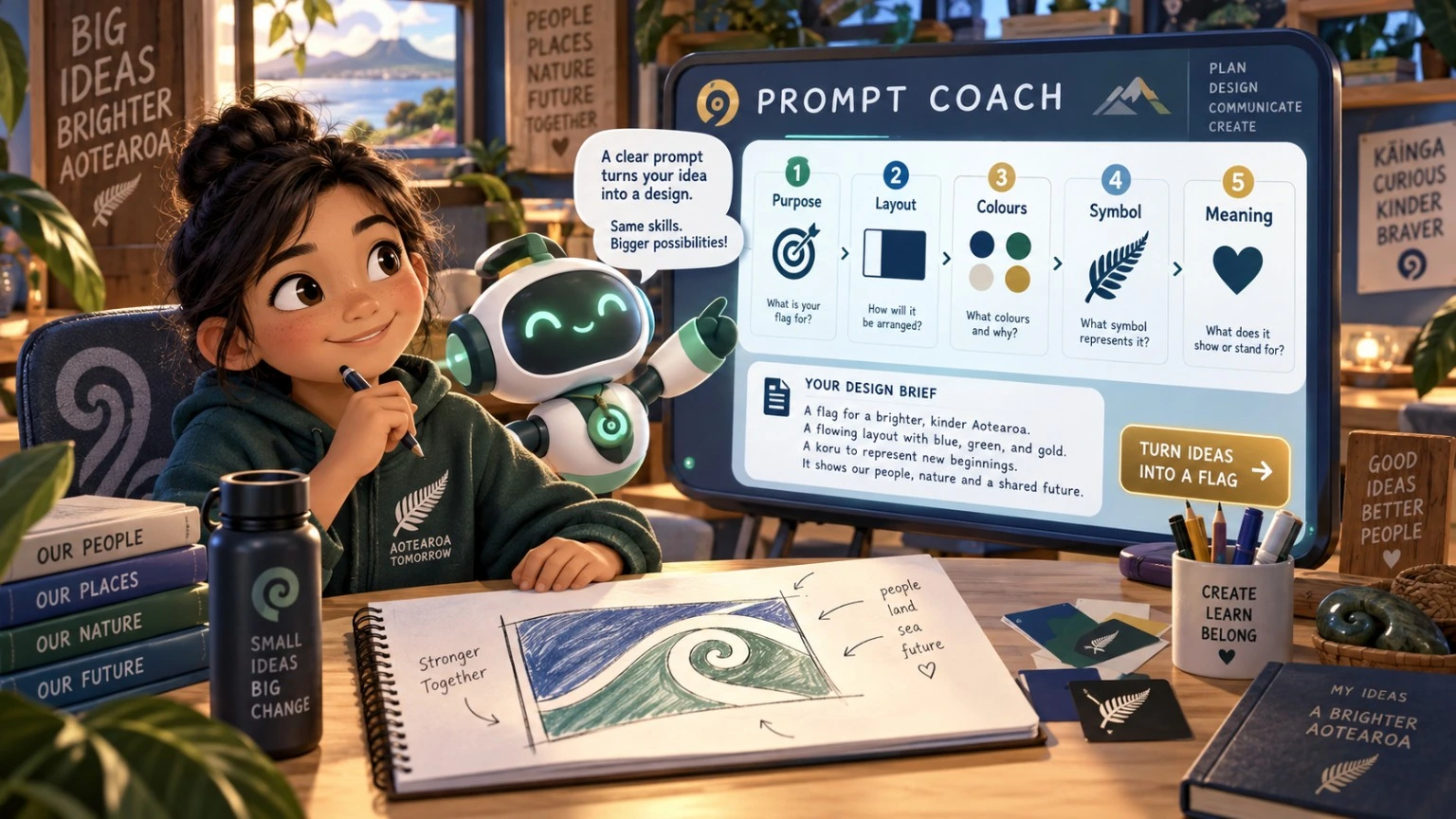
PROMPT RECIPE
1PurposeWhat is the fictional flag for?
2LayoutHow are the parts arranged?
3ColoursChoose two or three.
4SymbolUse one clear main symbol.
5MeaningExplain what your choices are intended to represent.
6ConstraintsSimple shapes, strong contrast, no readable text.
Digital safety: keep personal details out of the design brief. You do not need a full name, address, school name, face, phone number or other private information.
YEAR 5 DEEP DIVE · REQUIRED Complete this deeper Year 5 mahi as part of the mission — not as an optional extra.
Do the main mission first, then complete this section. It is deliberately more independent than Year 4 and is part of your weekly homework workload.
YOU TRY
Write a flag design brief with a clear user or community, purpose, three criteria and one constraint.
Minimum guide: 110 words. Quality matters: make the reasoning, evidence or design decision clear. □ answers the exact task□ uses specific detail□ ideas are connected□ reread and improved
MATHS
Flag Geometry Lab
04 · Geometry LabWork through one maths question at a time. Your answers will be checked before the next mission unlocks.
WHAT AM I LEARNING?
I can reason with angles, coordinates, symmetry and transformations.
YOUR MISSION
1) Half-turn symmetry angle 2) One quarter of a rectangle as percent
TEACH · LEARN THE IDEA
Geometry uses precise language. Describe location with coordinates, turns with angle measures and transformations by what changes or stays the same.
- STEP 1Read the question and decide what you need to find.
- STEP 2Notice the important numbers and units.
- STEP 3Choose a strategy and work it out.
- STEP 4Type the answer, then check that it makes sense.
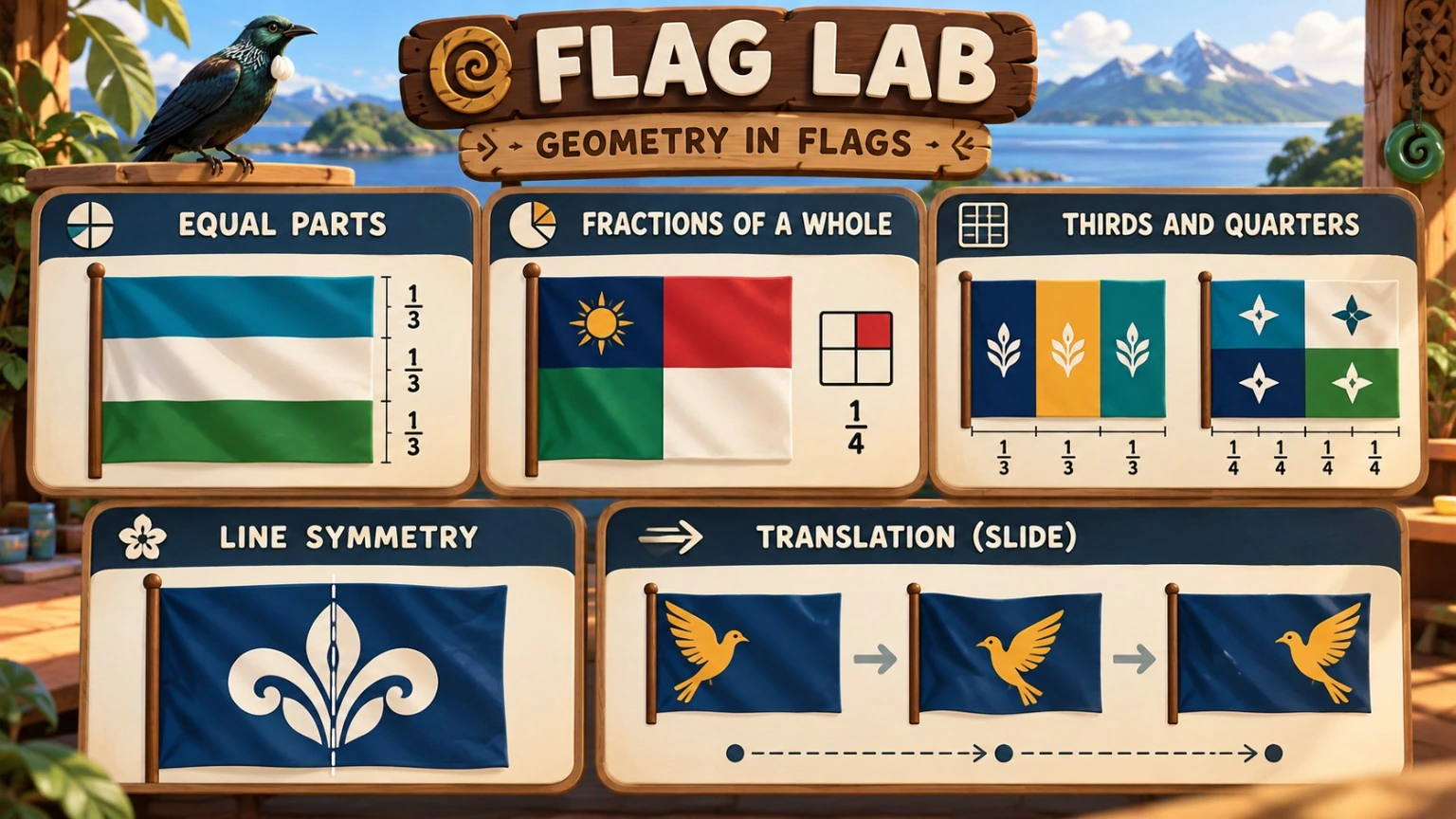
1/3One of three equal bands
1/4One of four equal panels
↔Line symmetry mirrors across a line
→Translation slides without turning or flipping
SOLVE · ONE AT A TIME
YEAR 5 DEEP DIVE · REQUIRED Complete this deeper Year 5 mahi as part of the mission — not as an optional extra.
Do the main mission first, then complete this section. It is deliberately more independent than Year 4 and is part of your weekly homework workload.
CORE YEAR 5 QUESTIONS
THE ARTS · TECHNOLOGY
Design, Test & Improve Your Flag
05 · Design StudioThis is your real-world Flag Lab: Symbols of the World challenge. Work out what the problem asks you to find or make.
WHAT AM I LEARNING?
I can design, test and improve an idea against criteria.
YOUR MISSION
Describe your flag idea, test it against two criteria and identify one change you would make after testing.
TEACH · LEARN THE IDEA
Design is iterative. Create a first solution, test it against clear criteria, identify a weakness and make an improvement.
- STEP 1Read the whole challenge once.
- STEP 2Find the numbers, facts or rules you need.
- STEP 3Choose a useful strategy.
- STEP 4Show your solution clearly enough that someone else could follow it.
STEP 1 OF 3 · DRAFT
STEP 1 · DRAFT
Sketch one rough idea
This draft is for thinking, not perfection. It is not stored as a large image file — only your final builder choices are saved.
STEP 2 · BUILD
Turn your idea into a clean flag
Choose a layout, three colours and one clear symbol. The preview updates on your device only.
Your flag is built locally in your browser. No image or personal information is uploaded.
STEP 3 · TEST + IMPROVE
Use one piece of feedback
Ask someone what they notice first. Then decide whether a change would help your flag communicate its purpose more clearly.
YEAR 5 DEEP DIVE · REQUIRED Complete this deeper Year 5 mahi as part of the mission — not as an optional extra.
Do the main mission first, then complete this section. It is deliberately more independent than Year 4 and is part of your weekly homework workload.
YOU TRY
Describe your flag idea, test it against two criteria and identify one change you would make after testing.
Minimum guide: 80 words. Quality matters: make the reasoning, evidence or design decision clear. □ answers the exact task□ uses specific detail□ ideas are connected□ reread and improved
SOCIAL SCIENCES
Flag Passport
06 · Passport ArcadeGAME BREAK
Collect eight passport stamps. Every answer comes from the Flag Lab lessons. A wrong answer is safe — use the clue, try again and keep your stamp progress moving.
ROUND 1 / 8STAMPS 0 / 8
12345678
Which country uses this flag?
YEAR 5 DEEP DIVE · REQUIRED Finish the game, then prove the learning in the final rounds.
Do the main mission first, then complete this section. It is deliberately more independent than Year 4 and is part of your weekly homework workload.
YEAR 5 GAME CHECK
Finish the game first, then use the learning from this week to clear these three final rounds.
How did Week 6 feel?
07 · ClubhouseThis part is about your own learning. There are no right or wrong feelings.
WHAT AM I LEARNING?
Reflect on independence, challenge level and the next useful Year 5 practice step.
YOUR MISSION
Which design criterion led to the biggest improvement?
TEACH · LEARN THE IDEA
Choose what feels true for you, then write one thing you understand better now.
- STEP 1Choose how the week felt.
- STEP 2Write one thing you understand better now.
How did this week feel?
There are no right or wrong answers. Choose what feels true for you.
FLAG DESIGNER BADGE EARNEDYou completed all seven Flag Lab missions.